
by Felix Wong |
What They Got Right: The Frame
The CAAD13, launched in 2019, was a technically accomplished bike that was embarrassed about what it was. Cannondale designed its aluminum tubes to mimic the SuperSix EVO’s dropped seatstays and aerodynamic profiles—borrowing the silhouette of a contemporary carbon race bike without the engineering rationale or wind-tunnel testing that could substantiate quantitative aerodynamic claims, claims the company did not even bother to make. It borrowed the SuperSix’s visual language so thoroughly that the main thing giving it away as aluminum was the welds, which by the CAAD13 era were notably rougher and chunkier than those of older, American-made generations.
The CAAD14 does away with all of that. The seatstays return to their traditional, high-mounted position. The top tube runs parallel to the ground. The tubes are round, straight and large-diameter, as they were in Canny’s era (all subsequent CAAD iterations had some sort of hydroforming and ovalization going on).
The silhouette is the classic double-diamond that defined not just Cannondale’s identity but the entire history of the racing bicycle before a decade of dropped seatstays convinced everyone that a bike had to look like a melting carbon ingot to be fast. Cannondale’s tagline for the CAAD14—”Not carbon. Not sorry.”—is the first piece of bicycle marketing copy in recent memory that made me genuinely smile.
The hourglass-shaped chainstays, which Cannondale introduced with the CAAD4 in the late 1990s and carried through many subsequent generations as a claimed comfort feature, are also gone. I was never a believer; sure, they looked kinda cool, but seemed more of a gimmick than a bona fide benefit. The complexity and additional weight those curves added seemed to me a textbook case of marketing solving a problem that wider, supple tires and lower pressure had already solved more elegantly. On the CAAD14, the stays are straight. Good.
The Welds
This is where things get interesting, and where Canny’s story becomes directly relevant.
When Cannondale was manufacturing its frames in Bedford, Pennsylvania—which it did until 2009—the company applied two passes of welding material and then sanded one of them down by hand to produce the smooth, almost seamless transitions that became a Cannondale trademark. It was labor-intensive and slow, which is partly why the practice largely disappeared after production moved to Taiwan. The CAAD10’s, CAAD11’s, and CAAD13’s (there was no CAAD12) rougher welds were a visible symptom of that transition.
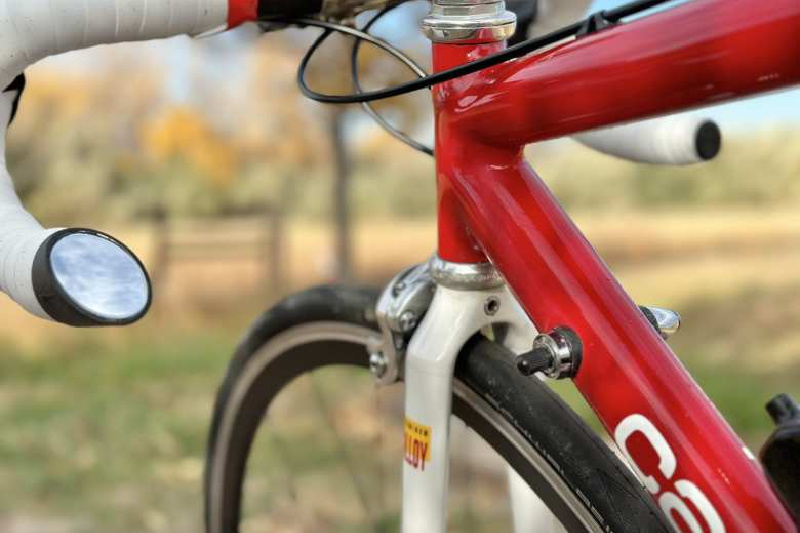
The CAAD14 represents a genuine effort to address this. Apart from the raw, lighter, limited-edition clear-coated version—which Cannondale hand-selects from the production line, choosing only frames with the cleanest welding before applying a thin clearcoat over brushed aluminum—the welds are virtually invisible.
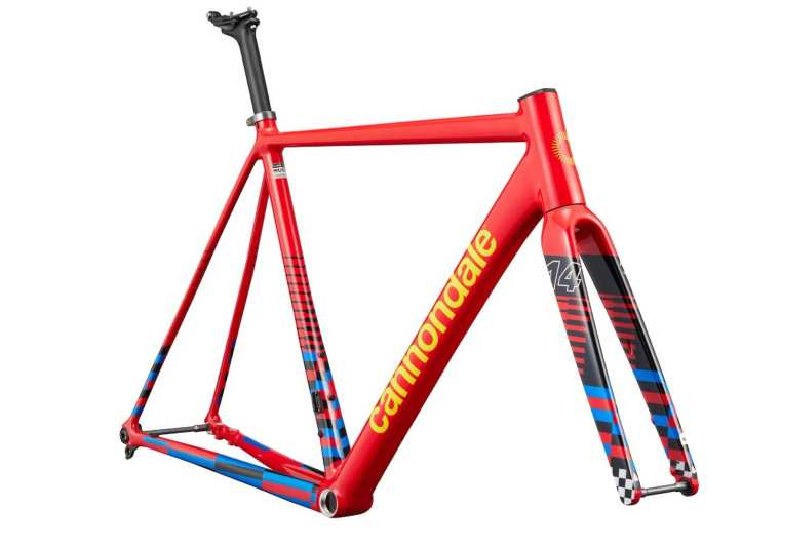
For the painted frames, which constitute the vast majority of production, the welds appear to be smoothed with some kind of body filler before paint is applied—a process not unlike automotive bodywork. Cannondale has not officially confirmed using something like Bondo, but the joints are way smoother than the CAAD13. Whether that smoothing is achieved by careful filler work or (less likely) their traditional double-pass-weld-then-sand technique, the aesthetic outcome is closer to what Canny looks like than any aluminum bike Cannondale has produced in the Taiwan era.
The Weight Question
Here is the one development I find genuinely curious. The CAAD14’s painted frame weighs 1,410 grams in a size 56, versus approximately 1,182 grams for the painted CAAD13 in the same size. That is a difference of 228 grams—half a pound—which is not trivial and seems like a step backward.
What’s striking is that the CAAD14’s painted frame weighs essentially the same as Canny’s original frame (which weighed 1,371g in size 53). And when built up in its top guise as the CAAD14 1 with one-piece SystemBar cockpit, Force XPLR AXS and Reserve 57/64 carbon wheels, it weighs 8.16 kilograms (18.0 pounds) in size 56 (source: CADE Media). That’s actually heavier than Canny, who weighs 7.91 kg (17.4 lbs.)
Cannondale has been careful not to apologize for this, arguing that the goal was not to build the lightest aluminum frame but to capture a specific ride character. That argument has merit: the non-compact geometry means longer, heavier seatstays; the round large-diameter tubes add material; and if the weld-smoothing filler process is real, it contributes a few grams as well.
The context worth keeping in mind is that when Canny was built, her weight was genuinely revolutionary. Her frame weight of 3.0 pounds is the reason for the moniker “3.0.” That bicycle frame was lighter than not only all steel, titanium, and competing aluminum frames, but virtually any carbon frame available on the market at the time, including bonded Trek and Specialized frames that predated OCLV carbon.
But that was 33 years ago, and now virtually all carbon road frames weigh significantly less. The CAAD14 isn’t competing on weight, and Cannondale knows it.
What’s Actually New
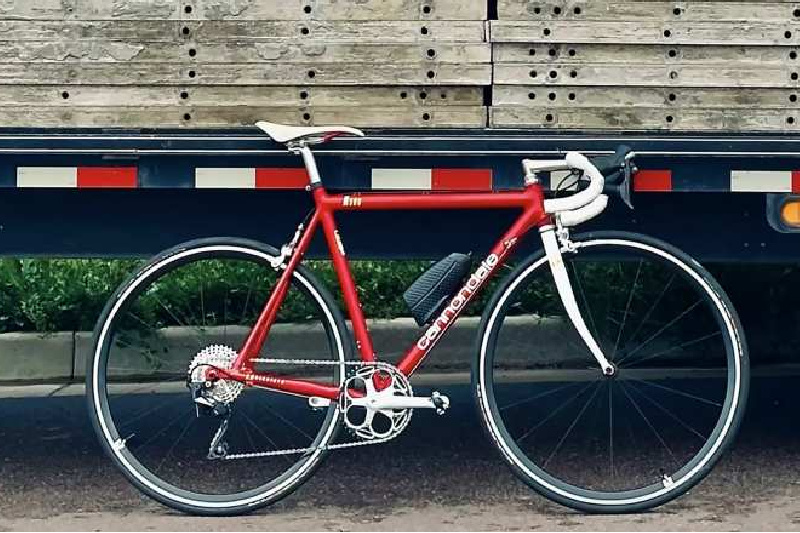
Visually, the CAAD14 resembles Canny in the same way Jane Fonda’s granddaughter, Viva, could be her doppelgänger—especially the limited-edition model with a 1X drivetrain. That mirrors the setup I converted Canny to a few years ago—albeit with two more cogs and electronic shifting.
But there are meaningful differences underneath.
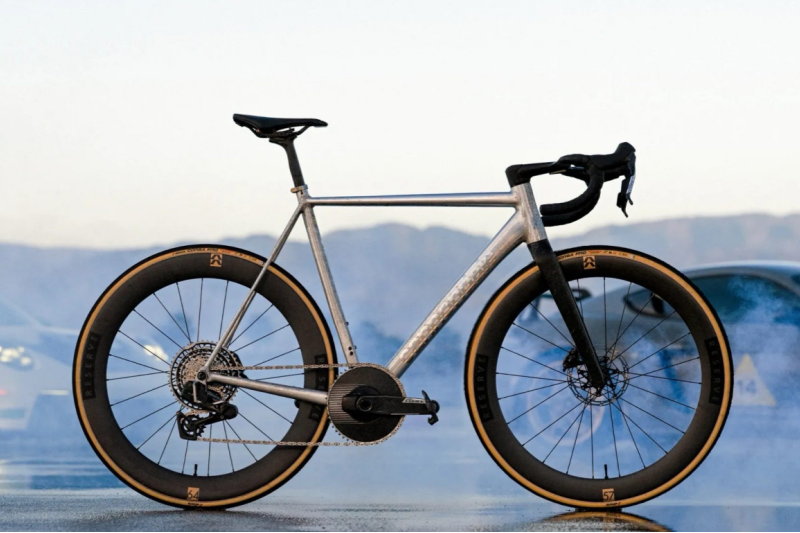
Disc brakes are the most significant. I know this was a contested topic for years in road cycling circles, but for me the argument has long been settled. Disc brakes, coupled with hydraulic fluids instead of cables, deliver better modulation and stopping power especially in wet weather. They also allow the use of lightweight, aerodynamic, deep-section carbon wheels without compromising braking performance because carbon rims don’t need to double as a braking surface.
The second major update is fully internal cable routing, made possible by Cannondale’s Delta steerer, which routes cables and hoses cleanly through a triangular fork steerer and into the headtube without requiring a proprietary headset. The result is a visually clean front end that previously required buying a carbon bike to achieve, if you wanted to stick with the Cannondale brand. I know that some people complain that it makes a bike harder to service—e.g., for stem and headset replacements that, let’s be honest, most people rarely ever need to do. But it looks so much better than external “spaghetti” that going forward, I’d never buy a high-end bicycle that doesn’t feature hidden cable routing.
Several other updates fall into the pleasant category of reversions—cases where Cannondale has walked back decisions that never needed to be made in the first place. The threaded BSA bottom bracket replaces the lighter BB30 press-fit shell that Cannondale championed for decades; BSA is what Canny uses, and it is what virtually every mechanic on the planet prefers working with. The seatpost returns to a standard 27.2mm round diameter, which means any compatible post from any brand drops straight in. It also uses an external seatpost collar. These are unglamorous decisions that will be appreciated by amateur home mechanics.
Then there is the Universal Derailleur Hanger, a SRAM innovation which deserves its own moment. Cannondale was actually one of the first brands to popularize the replaceable rear derailleur hanger when the 3.0 came out. The idea was elegant: if you crash and bend or break the hanger, replace a small aluminum tab rather than repairing or replacing the whole frame. For decades, however, each brand used its own proprietary hanger design, which meant hunting down an obscure part number and special-ordering it from the manufacturer.
I have bent the hanger on Canny, and more recently on my Litespeed Archon C2 when it was being shipped—not enough to break it, but enough to throw shifting off noticeably. The UDH standard changes all of this. Every shop stocks it. And when paired with SRAM’s Transmission drivetrain, it’s essentially impossible to bend the hanger in the first place because the derailleur mounts rigidly to the dropout rather than hanging from a thin tab. It’s fantastic that CAAD14 has UDH, and honestly, it’s overdue. Even though many, perhaps most manufacturers not named Trek (BMC, Pinarello, Specialized, etc.) have yet to adopt it for their WorldTour bikes, I’m certain they will in their next iterations due to the advent of the SRAM Red XPLR gruppo.
On the practical side, the CAAD14 officially supports tires up to 32mm—much wider than Canny can accommodate in the rear, where I suspect 25mm or 26mm is the practical maximum. Thirty-two millimeters opens up a significant comfort and traction advantage, particularly running tubeless. I have been running tubeless on Canny for about 12 years, albeit with 25mm tires (which seem positively narrow now by current standards), and I have never found the aluminum frame overly harsh.
As I recalled in an earlier post, back in Canny’s heyday many internet types such as the late Jobst Brandt insisted that that the “aluminum beats you up” reputation was a myth and fabrication of the mind, given that tires, saddle, and handlebar tape deflect orders of magnitude more than double-diamond frame tubes. Wider tires and lower pressure are the real ride quality lever.
The CAAD14, with its 32mm clearance, accepts that point almost automatically.
The Logo
One more thing that deserves acknowledgment: in roughly 2019, Cannondale returned to its classic lowercase sans-serif wordmark after most of the 2010s when the brand used a blockier, slanted version for the CAAD8 up to the CAAD11. In my eyes, the original logo is far more attractive.
It’s a small thing that makes a huge difference from both an aesthetic and nostalgia standpoint. Kudos to whoever in Cannondale’s marketing department made that decision.
The Price Problem
And now, the part that gives lots of CAAD fans pause, me included.
As I already mentioned, in 1993, I paid $600 for Canny before California sales tax. Adjusted for inflation, that is roughly $1,344 in 2026’s dollars—and that was a complete bicycle with Shimano RX100 components, roughly the same tier as 105 in Shimano’s hierarchy. She also was hand-crafted in Bedford, Pennsylvania and proudly wears a “Handmade in the USA” decal under clearcoat.
In contrast, the CAAD14 frameset alone—frame, fork, and seatpost, no components—retails for $1,800 despite being largely made by cost-efficient robots in Taiwan. The entry-level complete bike, equipped with Shimano 105 mechanical shifters, costs $2,500. The top-tier CAAD14 1 with clearcoat instead of paint (and thus a lighter frameset by about 130g), SRAM Force XPLR AXS and Reserve carbon wheels is $7,500. The latter may sound absolutely ridiculous even when considering pro bikes on the WorldTour cost double that amount, but it sounds like the “1” is intended to be a collector’s item limited to only 300 units.
The value equation that made the CAAD series legendary—competitive race performance at prices that even a poor college student could buy one—is no longer quite what it was. To be fair to Cannondale, it is not pricing in a vacuum—and surely they looked at the competition before deciding what they could get away with on their price.
The popular, heavier Specialized Allez Sprint frameset retails for $1,700 with ugly toothpaste welds. The much better-looking but equally heavy UDH-equipped Road Al frameset of BlackHeart—a boutique manufacturer in Truckee, California that has their frames built in Asia but does the assembly work in-house—also goes for $1,700.
The German brand Standert makes an aluminum race frame with round tubes and tall seatstays that surely was inspired by CAAD frames of old. It has built its own devoted following largely through Instagram and cycling’s bike-porn subculture, and charges 2,000€ (around $2,300) for its Kressäge SL frameset.
Against those comparisons, the CAAD14’s $1,800 frameset, with its smoothed welds and Cannondale’s depth of aluminum engineering, looks defensible.
Where it gets harder to justify is the comparison to carbon alternatives. Cannondale’s own SuperSix EVO 6—a full carbon race bike with Shimano 105 mechanical—retails for $3,000, just $500 more than the similarly equipped CAAD14 3. At that spread, some riders will look at the two bikes and choose carbon without much anguish.
There are options, of course, from other brands. For instance, State Bicycle Company of Arizona offers its Chinese-made, open mold Carbon Road Bike frameset for $1400–1700. Not only is it cheaper, but it’s lighter and more aerodynamic as well. Ex-pro cyclist Phil Gaimon just set a Mauna Kea hill-climbing record riding one. If not for the name on the downtube and online sales only, I bet many cyclists would likely choose that bike instead.
Clearly, then, the CAAD14 will need to sell its ride character and its identity now and not its price tag. Cannondale seems to understand this, hence their advertising tagline, “Not carbon. Not sorry.”
My Verdict, From the Sidelines
I have not ridden the CAAD14. I may never own one—Canny is not going anywhere, and my next bike will likely be made of carbon fiber due to still being something of a weight-weenie at heart. But as someone who has spent 33 years with one of the bikes the CAAD14 is consciously channeling, I find the whole thing deeply satisfying.
Cannondale got the CAAD series right the first time. They drifted from it in ways both subtle and obvious over the years—the aero tubes, the dropped seatstays, the unsmoothed welds, the identity crisis of the CAAD13.
The CAAD14 goes back to the 3.0 formula while incorporating modern niceties—I’d argue must-haves—like disc brakes, fully internal cable routing, and UDH. It is an acknowledgment that the original instinct was correct: aluminum does not need to pretend to be carbon (or steel or titanium, for that matter). It needs to be the best version of itself, with round, thin-walled, oversized tubes that make it direct, immediate, communicative, and unapologetically alive in your hands.
Canny, parked in the garage, would agree.