Like most athletes juggling work, family, and life, I train within a narrow window. When I ride, it has to fit into about 90 minutes, start to finish. Because of that, every session needs purpose. I’ve always performed best in environments where effort is intentional and directly connected to a goal.
That’s exactly why indoor training has become one of the most powerful tools available to cyclists today.
And yet… still many riders struggle with it.
They believe indoor training is inferior to riding outside because they can’t do the same power and it doesn’t feel as good.
I used to feel the exact same way and still to this day have to mentally reset every time I switch from outdoors to indoors.
In fact, I disliked indoor training so much that I’d sometimes choose not to train at all rather than ride inside. Sounds familiar?
Over time, I realized the problem wasn’t the trainer, it was how I was thinking about it.
Once I changed that, everything changed.
Here’s the three-step process I developed to turn indoor training from something I dreaded into one of the biggest performance advantages you can get.
Step 1: Re-Engineer Your Vision
A better indoor training experience always starts with purpose.
Ask yourself three simple questions:
Why do I need to train?
Most answers sound something like:
“Because I want to get stronger at cycling. I love the feeling after I push myself. I love improving.”
How big of a role does consistency play in these goals of mine?
For every athlete, the honest answer is:
“Consistency with my program is the only way.”
What outcome can I get if I stay on track with my consistency?
“I will get measurable improvement.”
When you connect these three answers, indoor training stops being something you should do, and becomes something you must do to experience cycling the way you want.
That mental shift alone changes everything.

Step 2: Optimize Your Environment
Once indoor training becomes a “must,” your setup matters.
Here’s what I recommend:
1. A Smart Trainer
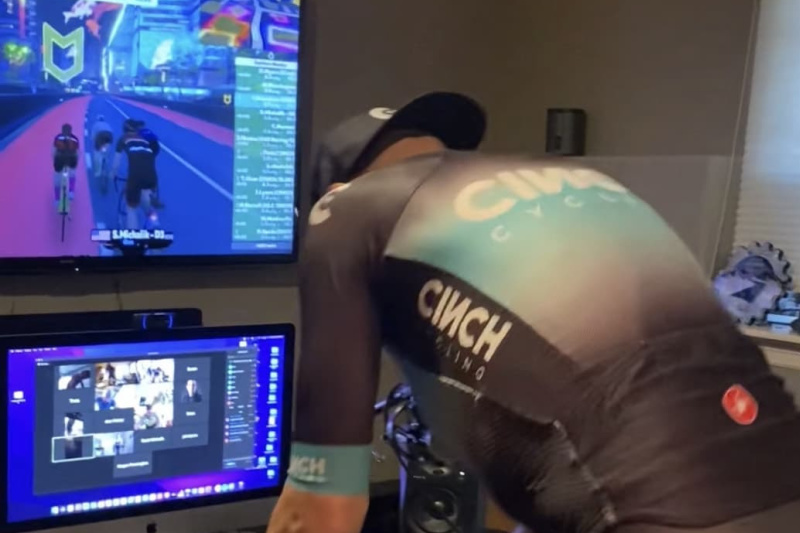
Modern trainers like the Wahoo KICKR replicate outdoor resistance incredibly well. Before smart trainers existed, indoor workouts had to be watered down. Now, you can match outdoor power, duration, and execution almost exactly.
2. Zwift
You don’t know how good you have it.
Back in the day (hahaha) when I was a teenager in Connecticut, I trained indoors for hours with a Walkman and a poster of Tinker Juarez. Zwift adds terrain changes, competition, and engagement, all of which make indoor work translate far better to outdoor performance.
3. A Powerful Fan
Cooling is non-negotiable.
Because you’re stationary indoors, core temperature rises quickly and limits performance. A strong fan dramatically improves workout quality and sustainability.

Step 3: Turn Struggle Into Opportunity
Now comes the real work (the good part!).
Indoor training exposes discomfort in its purest form, and that’s exactly why it’s valuable. Every struggle you experience indoors can be flipped into a performance advantage.
Let’s walk through how.
Struggle #1: “My bike doesn’t move.”
Opportunity: Practice riding relaxed
A relaxed body breathes better, pedals more efficiently, and produces more power.
I learned this lesson the hard way early in my Tour de France career. On my first major mountain stage, I froze. My arms tightened, breathing shortened, and my legs locked up. I was dropped instantly.
Once I refocused and relaxed, I climbed back to the leaders.
Indoor training is the perfect place to practice relaxation under stress. Lighten your grip. Relax your shoulders. Let that calm move all the way down into your legs.
Struggle #2: “It’s boring because I am going nowhere.”
Opportunity: Train pace changes
Cycling is not steady-state. It is accelerations, surges, and the followed by recoveries.
Indoors, you control your effort 100%, which can allow you to practice exact pace changes without terrain or group dynamics interfering. I ignored this early in my career and paid for it when I couldn’t handle accelerations in races.
Once I trained variability, everything changed. One standout example was my win at the Tour of Utah, where constant pace changes helped me drop Chris Horner on Empire Pass.
Struggle #3: “It’s lonely.”
Opportunity: Train humbly
Indoor riding removes ego.
There’s no “super pull” indoors, that unnecessary, ego-driven effort that burns matches and builds nothing. I’ve seen countless races decided because someone wasted energy showing off.
In fact, I won my first Grand Tour stage at the Vuelta a España after Alexander Vinokourov spent himself with repeated super pulls.
Train focused. Train controlled. The results will follow.
Struggle #4: “No speed = no fun.”
Opportunity: Practice fueling
Fueling is often neglected outdoors due to chaos and distractions.
Indoors is the perfect place to train your gut. Practice eating and drinking consistently, even when it’s uncomfortable. During races, this skill is non-negotiable.
I’ll never forget finishing my first Tour de France in Paris, and celebrating the fact that I didn’t have to eat another energy bar. Being able to eat a lot on the bike is a massive skill you need to practice.
Struggle #5: “This is boring.”
Opportunity: Practice attacking
Attacking is rarely trained and indoor riding makes it safe, repeatable, and honestly you can look as silly as you want as there is no one there to see you.
You also have no traffic, no corners, and there is no risk if you veer off your line or if your gear skips when you send it. There is the opportunity for full commitment. Watch pro races and you’ll see that attacks are always all-in. Indoor training is a great place to rehearse that effort.
Struggle #6: “Time just seems to stand still.”
Opportunity: Master discomfort
Cycling is a sport of overcoming.
Indoor training distills discomfort into its purest form, which makes it the perfect place to practice managing it. Learn to stay present. Learn to breathe through it. Learn to smile at it.
It’s funny, but so many people want to improve their climbing and indoor training really is the place to start to do it, at least mentally. The reality is the feeling that the pain seems to last forever while time stands still requires the same level of patience and discipline to get through just like getting up a climb.
Heck, you can even have some fun with it and put a mirror in front of you to practice your best Tour de France suffer face.

Final Thoughts
This winter, flip the script and your perspective on indoor training.
Re-engineer your vision.
Optimize your environment.
Turn struggle into opportunity.
Indoor training doesn’t have to make you miserable, instead use it to make you better.
Now go attack it! ALL IN 2026!