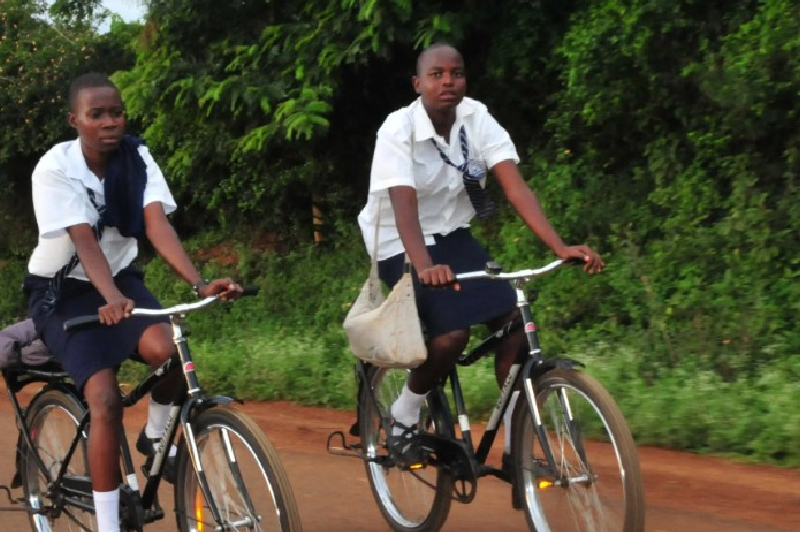
For millions of girls in the developing world, the path to an education is not a simple journey from home to a classroom; it is a long and often perilous road fraught with dangers that threaten their safety and their future. Distance is a formidable barrier, but the risks that accompany it—harassment, violence, and abduction—are even more daunting. In this context, a simple, two-wheeled machine is emerging as a powerful catalyst for change: the bicycle. By providing a means of faster and safer travel, bicycle programs are not only increasing school enrollment and attendance but are also becoming a critical tool in the fight against gender-based violence and human trafficking.
The Perilous Journey to School
Across many developing nations, the distance to the nearest school is a significant obstacle to education, a problem that disproportionately affects girls. According to the World Bank, the proximity of a school is the single most important determinant of primary school enrollment . In sub-Saharan Africa, for instance, more than a quarter of primary school children live over two kilometers from their school, and secondary schools can be hours away on foot .
These long walks are not merely an inconvenience; they are a daily source of vulnerability. A 2003 report by Human Rights Watch (HRW) highlighted that the lengthy commute to school is a major factor in girls’ risk of sexual abuse, whether from minibus drivers, conductors, or others they encounter along the road . The report documented cases in Zambia and South Africa where girls were forced to walk for two hours or more, sometimes staying in insecure sheds near their schools, which exposed them to further abuse. The daily journey often begins before dawn and ends after dusk, compounding the risks. Fearful for their daughters’ safety, many parents choose to pull them out of school altogether, a decision that contributes to the stark statistic from UNESCO that only 1% of the poorest girls in low-income countries complete secondary school .
This vulnerability extends beyond harassment to the grave threat of abduction and human trafficking. The International Organization for Migration (IOM) reports that while boys are more often trafficked for forced labor, girls are predominantly targeted for sexual exploitation . The long, unprotected journeys to and from school present a window of opportunity for traffickers. The IOM’s analysis of nearly 69,000 trafficking cases revealed that more than half of child victims are trafficked within their own countries, often recruited by familiar faces, making the isolation of a long walk even more dangerous .
Evidence from the Field: Bicycles as a Catalyst for Change
Recognizing these intertwined challenges, non-governmental organizations and governments have initiated programs to provide bicycles to girls. The results, backed by rigorous research, demonstrate a profound impact on education, safety, and empowerment.
Two landmark programs, one in Zambia and another in the Indian state of Bihar, offer compelling evidence of the transformative power of bicycles.
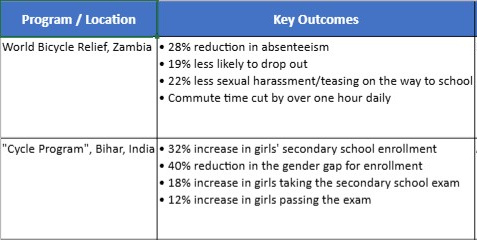
In Zambia, a partnership between the Ministry of Education and World Bicycle Relief has provided nearly 37,000 bicycles to rural girls. A randomized control trial of the program found that besides the dramatic improvements in attendance and dropout rates, girls with bicycles reported experiencing 22% less sexual harassment and teasing during their commute . The simple act of moving faster reduces the window of vulnerability, making them less of a target for would-be assailants.
In Bihar, India, the government’s “Cycle Program” was designed specifically to address the gender gap in secondary education. A study published in the American Economic Journal found the program increased girls’ age-appropriate enrollment by a remarkable 32% and closed the gender gap by 40% . The study’s authors concluded that the impact was primarily driven by the reduction in the time and safety cost of school attendance, with the largest enrollment gains seen in villages furthest from secondary schools.
Beyond the Classroom: A Ripple Effect of Empowerment
The benefits of a bicycle extend far beyond simply getting to school. The Zambian study noted that girls in the program reported feeling more in control of the decisions affecting their lives, ranked themselves higher academically, and had a greater belief in their own potential . A bicycle provides more than mobility; it delivers a sense of independence and self-reliance.
The time saved on the commute—often over an hour each day—can be reallocated to studies, chores, or simply rest, combating the exhaustion that plagues many students who endure long walks. As one father in the Zambian program remarked, his daughter, equipped with a bicycle, was suddenly “more intelligent.” The researchers noted, “She didn’t suddenly gain IQ points. She gained time and energy” .
The evidence is clear: for girls in many developing countries, a bicycle is not a luxury but a lifeline. It is a cost-effective and sustainable intervention that directly addresses the critical barriers of distance and safety that prevent millions of girls from accessing education. By making the journey to school faster and safer, bicycles empower girls to stay in school, protect them from violence and trafficking, and unlock their potential to build a better future for themselves and their communities. As the world seeks solutions to achieve global education and gender equality goals, the humble bicycle proves that sometimes the most effective solutions are the simplest ones, putting the wheels of change in motion, one girl at a time.