By Ryan Mallon
SRAM has called for the cycling industry to have a “seat at the table” alongside riders, teams, and race organisers, as the components giant’s ongoing battle with the UCI over its planned gear restriction trial hits the appeals court in Belgium.
On Wednesday, a public hearing took place at the Markets Court in Brussels concerning the UCI’s appeal against the Belgian Competition Authority’s decision to order cycling’s governing body to suspend its proposed gear restriction trial, which had been set to take place at the Tour of Guangxi in China, in October.

SRAM had first launched legal proceedings against the UCI a month previously, the component manufacturer arguing that capping rider gear choice in races violates EU competition law and will unfairly impact and penalise the brand’s riders and teams, without increasing safety.
As part of a raft of controversial safety regulations announced in early 2025, the UCI planned to trial its new maximum gearing rule at the final WorldTour event of last season, the Tour of Guangxi, as part of its attempts to limit top speeds and reduce danger in the peloton.
> SRAM wins legal challenge to suspend “harmful” gear restriction trial – but UCI hits back by claiming “riders’ safety does not appear to be a shared objective”
This proposed rule, a variation on the old junior gears system, marks the first technical gear limitation in modern professional cycling and will cap the distance covered per pedal revolution to 10.46 metres – effectively limiting riders to a maximum gear ratio of 54×11 on 700c wheels.
Though we’ve seen many riders mix and match larger chainrings from other brands on their bikes in recent years, Shimano, Campagnolo, and FSA now all have maximum gear ratios of 54×11, meaning they would have been largely unaffected by the rule.
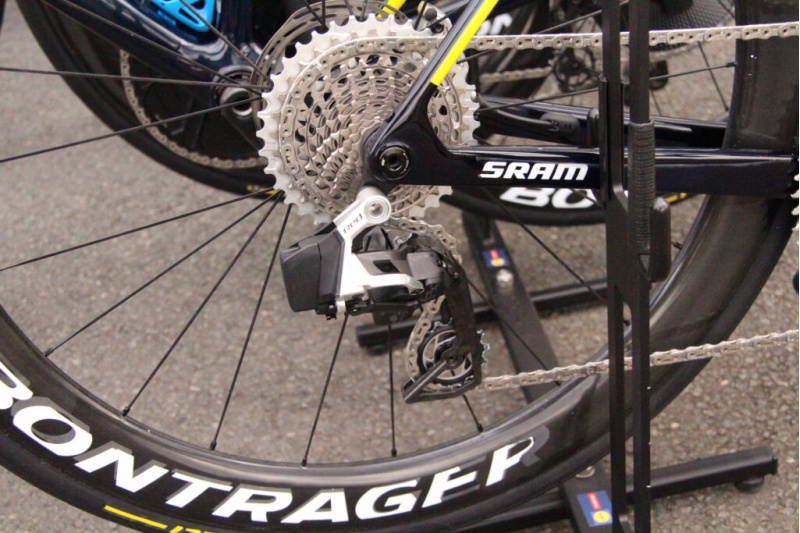
However, the trial system would significantly impact SRAM-sponsored teams, whose riders use a 10-tooth smallest cog on the rear cassette. Under the new 10.46 metre cap, any combination exceeding 54×11 is now prohibited.

This means, under the UCI’s plans, SRAM riders using a 10-tooth cog would be limited to a maximum 49-tooth chainring, ruling out the 50T and 54T setups that are common in the pro peloton, and the 54×10 configuration favoured by many of SRAM’s professional teams.
In its complaint to the Belgian Competition Authority (BCA), SRAM argued that the proposed protocol was adopted by the UCI without consultation, transparency, or any safety justification, disadvantages SRAM-equipped riders in races, and distorts the drivetrain market, violating EU competition law.
In October, just days before the trial was due to take place in Guangxi, the BCA issued a ruling bringing a halt to the UCI’s plans, arguing that the governing body’s basis for implementing the trial and determining new technical standards did not meet essential conditions of proportionality, objectivity, transparency, and non-discrimination.
The BCA claimed that the trial would have resulted in “undue restriction of competition between sports equipment suppliers”.
> UCI to trial maximum gearing rule — but will it really make racing safer?
However, the UCI immediately hit back at the ruling, noting its “surprise” at the intervention (and, rather bizarrely, the international character of the complaint), while also criticising SRAM and accusing it of failing to prioritise rider safety.
The governing body also said it would appeal the ruling – in the form of a 70-page document – and since then has been exchanging a series of writs with the BCA.
A first public hearing concerning this legal battle took place on Wednesday, where it was announced that a final decision – which could have serious consequences for both cycling and sport in general – will be made by 20 May.
“Today, we asked the Brussels Markets Court to uphold the Belgian Competition Authority’s decision suspending the UCI’s Maximum Gear Ratio Protocol,” SRAM CEO Ken Lousberg said in a statement following the hearing.
“We believe the BCA got it right the first time and agree with their conclusion that the UCI’s rule-making process is not transparent, objective, or non-discriminatory.
“Rider safety is very important to us; we build components that get pushed to their limits by the best cyclists in the world. What we want is simple and has not changed.
“The cycling industry, represented by the World Federation of the Sporting Goods Industry (WFSGI), deserves a seat at the table with the riders, teams, and race organisers.
“Our sport deserves this level of professionalism and collaboration. SRAM remains eager to work with the UCI to build a better future for the sport we love.”
By Ryan Mallon