Eliminate the guesswork with a systematic approach.
Drinking during endurance exercise seems like a no-brainer. We know we have to drink—we’ve had it drilled into our heads from the start. Talk of the health and performance benefits of the proper hydration balance are all around us.
Despite the advice of coaches and cycling friends and the abundant media sources agonizing over the topic, finding the balance is hit or miss for some. We know we have to drink, but few of us know how much is optimal, how to find out, or why.
What’s more, even fewer are aware of the dangers associated with improper hydration practices. Sure, if we don’t drink enough, we may become dehydrated. The research is conflicting regarding performance-limiting factors, but excessive dehydration can become a severe health issue.

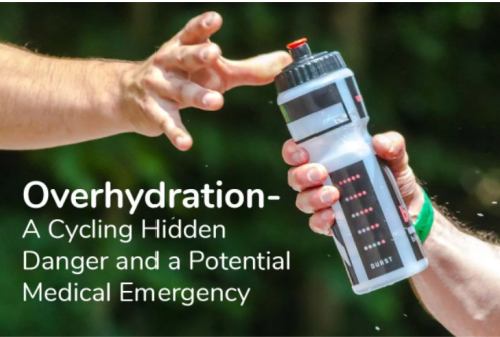
Little known among the cycling community are the risks of overhydration. The excessive consumption and retention of dilute fluids have dire consequences. Overhydration is a potentially life-threatening hidden risk to endurance athletes.
Either way you turn, there is no getting away from the fact that a solid hydration strategy is essential. When you’ve come to that fork in the road, the divergent paths of hydration primarily lead to two places— Drinking when thirsty and Individualized Planned Drinking.
Thirst vs. Drinking
Thirst is the act of seeking and consuming water and is measured using a subjective rating scale. Drinking is a behavior whereby fluid selection is influenced by preferences, like ingredients, calorie content, temperature, taste, and consumed fluid volume is how it is measured.
Our body properly regulates total water volume and blood concentration within 1-3% from one day to the next during regular activity. A choreographed interplay between the perception of thirst, drinking behaviors, and physiological responses keeps our fluid-electrolyte balance right where we want it to be.
However, during prolonged exercise performance, the relationship is distorted. Substantial water and sodium losses in sweat, blood volume decreases, and fluid transfer in and out of our cells complicate the issue. It becomes more than an issue of drink when you are thirsty, for some, that is!
Why do we get thirsty?
Dehydration concentrates the fluid surrounding our cells and is considered the primary factor governing thirst. Unfortunately, data shows that the threshold for thirst perception is not uniform. The level of dehydration and fluid concentration that prompts drinking during exercise differs significantly between athletes.
Other factors, like dehydration of our cells, decreased blood volume and pressure, and mouth dryness, also contributes.
Why do we drink?
Competitive seasoned athletes look to social media, print magazines, scientific journals, nutritionists, and fitness professionals as reliable sources of hydration information.
The unique nature of competitive events also influences drinking. No cyclist likes to drink when the pace is high, and losing focus could be the difference between selection and getting spit out the back. Runners can only take on water at aid stations, and triathletes can’t drink when they swim.

Drinking When Thirsty vs. Individualized Planned Drinking
Prolonged endurance exercise challenges thirst and drinking to maintain an athlete’s safe fluid-electrolyte balance. Sizable sweat losses of water and sodium throw off our blood concentration and deplete plasma volume.
Despite this, many athletes find themselves in a state of voluntary dehydration when the perception of thirst doesn’t sufficiently maintain fluid intake matching dehydration.
Post-event ratings of thirst have found an insignificant correlation with total fluid intake—a measure of drinking behavior. In addition to changes in body mass and body water balance, the difference between consumed fluid and the volume of fluid lost.
Moreover, sensory signals like rapid swallowing and moisture in our mouths limit fluid intake by sending signals that we are satisfied to our brain, even if it’s a small amount. In short, the intensity of thirst does not represent the degree of dehydration of the volume of fluid consumed in most cases.
The systematic plan eliminates much of the guesswork based on an objective sweat rate measurement. Once sweat rate is determined, the athlete designs a customized hydration plan, careful to intake less fluid than they lose to avoid overhydration and weight gain.
Calculating Your Sweat Rate
- Determine the amount of bodyweight you lost while riding by subtracting your pre-weight from your post-weight (unclothed).
- Add the bodyweight you lost to the amount of fluids you consumed (water, gels, etc.) during the duration of the ride to calculate your Sweat Loss.
- Divide your Sweat Loss by the amount of time you were on the bike to determine your Sweat Rate.
A Practical Example
- One pound is equal to 16 ounces of fluid. You have lost 8 ounces.
- You consumed 22 ounces of water during the ride.
- Your Sweat Loss is 8 oz. + 22 oz. = 30 oz of fluid loss.
- Divide 30 ounces by the length of your ride, 1.5 hours.
- Your Sweat Rate is 20 ounces per hour.
Conclusion