Bass belatedly releases Infrastructure Plan, LA belatedly proceeds with Forest Lawn Dr. project, and OC streets are appalling
 To steal from Hamlet, something is rotten in the state of Los Angeles.
Or so it seems, anyway, as Mayor Karen Bass belatedly released her Capital Infrastructure Plan after more than three years in office. Something she should have done on Day One.
At first glance, it doesn’t seem to pass the smell test, to mix metaphors.
Not only because it reads like a plan to develop a plan, but because it has to be read in the context of an unpopular mayor running for re-election.

If you read the press release, you’ll see a handful of city council members falling all over themselves to praise Bass and the CIP; notably absent is Councilmember Nithya Raman, one of the mayor’s primary opponents.
And you have to wonder if this plan has only been released at this late date because Raman has developed her own plan.
According to the press release,
Mayor Bass’ Capital Infrastructure Program lays out a comprehensive roadmap for L.A. to reform and improve the way it maintains and builds new infrastructure, including 10 recommendations to achieve this vision by reforming City processes and the Charter. Greater transparency is also achieved by laying out a data-based foundation regarding how and where the City must address short and long-term infrastructure needs.
Included in the program are 29 Olympic and Paralympic legacy capital projects that will both prepare the City for 2028 and leave lasting investments for communities across L.A. 16 of these capital projects are currently funded in Mayor Bass’ proposed FY 26-27 budget. Working alongside the City Council, the Mayor’s Office will seek to advance the reforms in the Capital Infrastructure Program and begin the long-term funding and planning for the proposed capital projects.
For years, advocates have called for simplifying LA’s overly complicated infrastructure process by removing the silos separating LADOT, Streets Services and the Bureau of Engineering and combining them into a single department.
Instead, the mayor’s plan calls for greater cooperation between those silos, while creating an additional layer of bureaucracy by strengthening the Capital Planning Steering Committee, giving the Bureau of Engineering responsibility for creating the CIP, and establishing a new Director of Public Works.
It also calls for prioritizing projects for the ’28 Los Angeles Olympics, rather than, you know, resurfacing streets and filling potholes.
Never mind building bus and bike lanes for the people who already live here. And if there’s any mention of complying with Measure HLA, as mandated by the city’s voters, I didn’t find it.
I’m also not thrilled by this line, which places blame on the public, rather than the people we elect to actually do the hard things:
Angelenos do not have a clear understanding of what can realistically be funded and when, nor the city’s long-term priorities beyond those of a given year.
Never mind that Bass doesn’t seem to have any problem approving unfunded pay raises for cops and other city employees. But the public clearly seems to be expecting too damn much.
Although Bass and her staff at least seem to have a reasonable grasp of the problems.
The city’s current capital planning process is falling short:
- Fragmented systems and data silos
- No shared vision across city departments
- Growing maintenance deferrals
- Slow, inefficient capital planning
- No capital project intake standards
- Limited project scoring and prioritization
- Highly decentralized and uncoordinated grants
- Limited analytical capacity and predictive modeling
- Resource planning and staffing misalignment
- An opaque capital planning process
- A growing need to quantify infrastructure needs
Missing from this list is the city’s endless series of public meetings before anything ever gets built, which stretches a process that could, and should, take months into years.
Many, many years, in some cases.
So this may be a good start. And it may even be an improvement over our current failed system.
But it’s about three years too late.
………
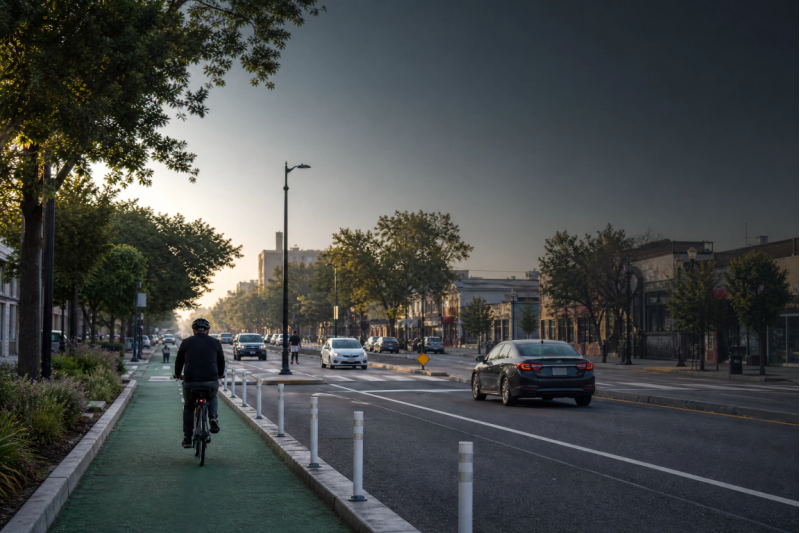
Speaking of Nithya Raman, her office announced the city is finally moving forward with the long-discussed Forest Lawn Drive Safety and Mobility Project, including what passes for protected bike lanes in the City of LA.
And yes, this should be seen in light of the mayor’s race, as well.
As should any pronouncements by anyone running for mayor for the next six months.
………
He gets it.
A writer for a Minnesota transportation advocacy site visits Orange County on a Costco packaged travel deal, and is suitably appalled by what he found.
Car dependency is a modern California birthright. It is very common to drive on avenues with 10 or more lanes and speed limits of 60 miles per hour. To be clear, that is an avenue with periodic traffic light intersections with five lanes in each direction and more turn lanes at intersections. The speed limits in Orange County were usually about 10 miles per hour higher than what would be expected in the Minneapolis-St. Paul area.
There were a small number of bicyclists. They typically were enthusiast athletes along Pacific Coast Highway and residents who cannot drive, like teenagers on a bike going to school. I felt sick for how dangerous the intersections were for these children. I also saw a family with a stroller crossing an unmarked intersection, and stopped my car to let them cross the street. Bike lanes are typically one line of paint and sometimes green paint at intersections. I did not see a single protected bike lane with any level of plastic bollard or curb protection. There were, however some multi-use paths in more recreational park areas. Practical cyclists — like the teenagers — typically rode on the sidewalk.
To be honest, it’s kind of pitiful and humbling, if not humiliating, the way people from other places see us.
Especially when they actually do.