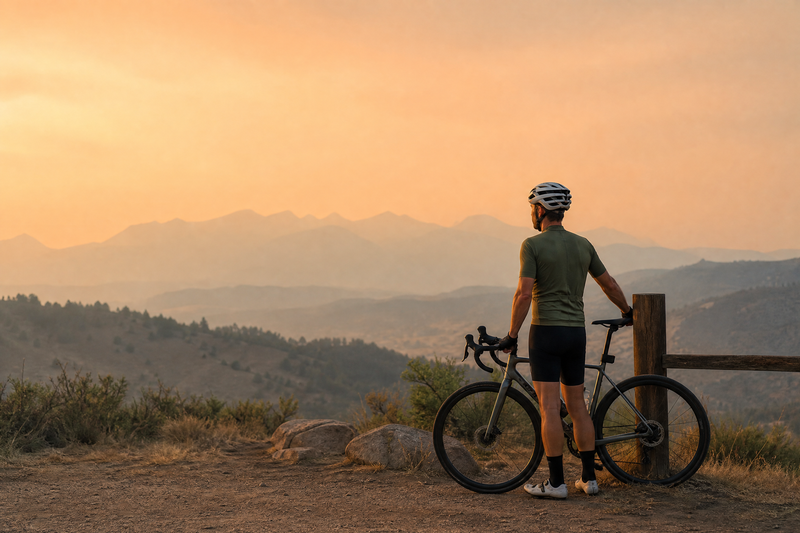
There is a moment every summer rider knows now: the day begins bright, the route is loaded, and then the horizon takes on an unfamiliar color. The question is no longer simply, “How far are we going?” It is, “Should we go at all?”
By: Gary Robinson, Avid Cyclist
The first clue is not always an alert on a phone. Sometimes it is the light.
The mountains that were crisp yesterday have softened behind a dull veil. The sun looks nearer, stranger, more orange than it should. The air carries a faint campfire smell that seems almost nostalgic until your throat notices it. For a cyclist with a long route in mind, the temptation is familiar: wait an hour, ride easier, take a mask, tough it out.
That instinct is understandable. It is also the wrong starting point.
Wildfire smoke and extreme heat have rewritten the summer-riding playbook. The new rule is not to prove how much discomfort a rider can tolerate. It is to make a conservative, current-condition decision before exertion turns a manageable exposure into a bad day—and to understand that the answer may be different at sunrise than it is at noon.
The Environmental Protection Agency warns that smoke and heat can each be dangerous, and that evidence suggests exposure to both at once may be worse than exposure to either alone.
The agency specifically identifies people exercising outdoors as a group at increased risk during these combined events. That matters to cyclists because hard breathing, long distance, changing terrain, and the temptation to “finish the route” all increase the stakes.
This is not a story about abandoning the bike. It is about learning to protect the thing cycling is supposed to build: health, joy, and the freedom to ride again tomorrow.
Smoke Is Not a Training Variable
Cyclists are trained to read discomfort as information. Heavy legs can signal a need for recovery. A high heart rate can tell you to settle down. A headwind can be managed with patience and gear choice.
Smoke is different.
Wildfire smoke contains fine particle pollution, often called PM<sub>2.5</sub>, that can affect the lungs, heart, and other organs. EPA guidance notes that smoke can aggravate asthma and chronic obstructive pulmonary disease and can increase risks associated with heart conditions. The Centers for Disease Control and Prevention adds that smoke can irritate the eyes, nose, throat, and lungs, and can cause difficulty breathing, coughing, or wheezing.
The core cycling problem is simple: the harder you ride, the more air you move. That is why official guidance does not offer a clever intensity hack for a smoky day. AirNow advises people to take it easier, avoid strenuous activity when it looks or smells smoky, and reschedule outdoor activities when air quality improves.
The mental reset: Smoke is not a badge of toughness, and a smoky ride is not a fitness test. It is an exposure decision.
That does not mean every hazy morning carries the same risk, or that an orange sky gives you a complete air-quality reading. It means appearance, smell, forecast conditions, and your body should trigger a check—not a rationalization.
The first piece of cycling gear on a smoke day is current information. Check conditions at your route—not only at home. Image illustration: AvidCyclist.
The Five-Minute Pre-Ride Check
A good decision begins with better questions. Before a summer ride, check the AirNow Fire and Smoke Map for the route area and review local smoke advisories. EPA also points riders to the CDC’s HeatRisk forecast and to local weather and heat-alert information.
Then resist the urge to turn one number into a universal rule. Conditions can change along a route, a rider’s risk factors matter, and smoke and heat may peak at different times. The EPA makes an especially important point for cyclists: the coolest part of the day can sometimes be the smokiest. “Just ride early” is therefore not a complete plan.
| Pre-ride question | Why it matters | A conservative response |
| What does the current air-quality picture show at my route, not just my house? | Smoke can be uneven across a metro area, canyon, valley, or mountain route. | Check the destination, route corridor, and return route. If conditions are deteriorating or unclear, shorten, delay, move indoors, or choose a different day. |
| Is there a heat advisory or elevated HeatRisk? | Heat raises physical strain and can compound smoke exposure. | Move the activity, reduce duration and intensity, or choose indoor movement. |
| What will my effort be? | Climbing, racing, long endurance rides, and group-ride surges increase ventilation and limit easy exits. | Do not convert a hard workout into a smoky “easy ride.” Pick a truly easy, short alternative only if conditions support it. |
| Can I turn around immediately? | Remote routes, exposed roads, and long loops remove options when conditions worsen. | Favor short, familiar circuits near indoor shelter, water, and a vehicle—or do not start. |
| How do I feel, and do I have risk factors? | Health status changes the decision. | Be more cautious if you have heart or lung disease, asthma, other chronic conditions, are pregnant, or have had symptoms. Seek personalized guidance from a qualified clinician. |
The most effective habit is not memorizing a threshold. It is creating a default off-ramp. If you cannot describe your plan for getting indoors, hydrating, cooling down, or ending the ride early, you do not have a smoke-and-heat plan.
Heat and Smoke Are a Bad Bargain Together
High temperatures already demand more from the body. Heat can make it harder to cool down and can contribute to conditions ranging from cramps and heat exhaustion to heat stroke. EPA identifies high humidity, high nighttime temperatures, alcohol use, some prescription medicines, and sunburn as factors that can raise heat-illness risk.
Add smoke, and the decision becomes more complicated. You may be tempted to ride during the cooler dawn hours, only to discover the air is more stagnant or smoky. Or you may wait for the smoke to thin, then confront an exposed route under intense midday heat.
There is no heroic solution to that trade-off. On some days, the answer is an indoor trainer, a gym, a swim, a walk in cleaner indoor air, or a genuine recovery day.
That answer may feel like a loss only if cycling is reduced to miles. It is not. AvidCyclist’s recent guide to recovery for heavy legs makes a related point: adaptation depends on recovery as much as effort. A smoke-and-heat day can become a useful interruption rather than a missed workout.
What an N95 Can—and Cannot—Do for a Cyclist
The public conversation around masks is often too blunt for a bike ride.
AirNow states that cloth masks do not protect against wildfire smoke and that N95 respirator masks can provide protection from it. CDC likewise advises a properly fitted, NIOSH-approved respirator if someone must be outdoors during smoky conditions.
But cyclists should not mistake that for an endorsement to conduct a hard ride in poor air. A well-fitting N95 is a tool for reducing exposure when outdoor time cannot be avoided; it is not a performance accessory or a permission slip for intense training. The EPA says to limit strenuous outdoor activity, keep monitoring smoke and heat, and remove a respirator if it becomes uncomfortably warm or contributes to symptoms of heat-related illness.
The practical rule: A respirator can reduce exposure during necessary time outside. It does not make a long, hard ride in unhealthy air a good idea.
If you need to be outdoors, lower the demand: make the trip essential, shorter, slower, and closer to a clean-air option. If the objective is fitness, reschedule or move the work indoors.
Learn the Difference Between “Uncomfortable” and “Stop”
Cyclists are not always good at listening to early warning signs. That trait can be useful in a final kilometer. It is not useful when smoke and heat are involved.
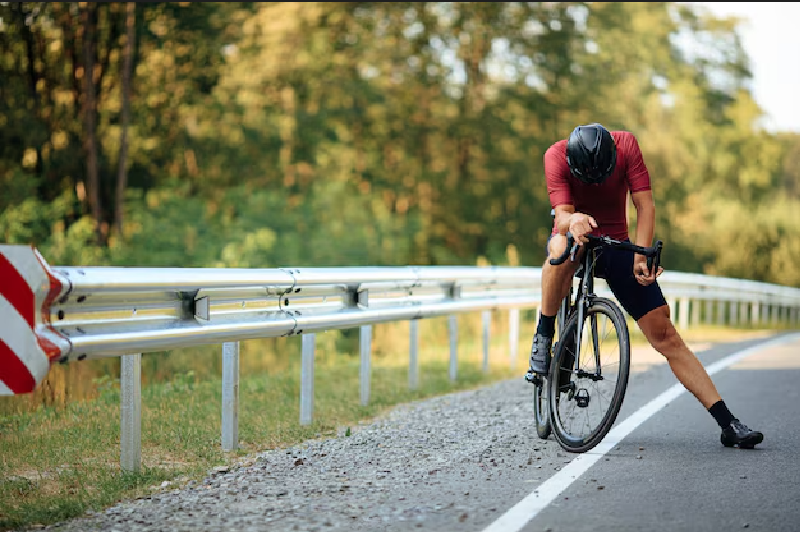
EPA lists early heat-related symptoms that include feeling unwell, headache, sweating and thirst, nausea, lightheadedness, fatigue, heat rash, and muscle cramps. Its guidance is to get somewhere cool and sip water until symptoms improve; seek medical attention if symptoms do not improve. EPA says serious signs such as fainting or loss of consciousness, weakness, extreme fatigue, severe nausea, or difficulty speaking require immediate medical attention.
Smoke can bring eye, nose, and throat irritation, coughing, or wheezing. CDC advises people to pay attention to symptoms and seek medical help for new or worsening symptoms, especially if they have relevant underlying conditions.
| What you notice | What to do immediately | What not to do |
| Smoke smell intensifies; eyes, throat, or lungs feel irritated | Reduce exposure; stop or move to cleaner indoor air rather than “riding through it.” | Do not use pace, power, or group momentum to override symptoms. |
| Headache, thirst, nausea, lightheadedness, cramps, or unusual fatigue | Stop exertion, cool down, hydrate appropriately, and reassess in a cool place. | Do not push to the planned turnaround point simply because it is closer on the route map. |
| Fainting, loss of consciousness, severe nausea, difficulty speaking, or severe weakness | Seek urgent medical attention. | Do not attempt to ride home. |
| New or worsening breathing symptoms, cough, or wheeze | Move to cleaner air and seek appropriate medical guidance, especially if symptoms are severe or worsening. | Do not assume a mask, an inhaler plan, or previous fitness makes the symptoms routine. |
This is general information, not medical advice or a personalized clearance to exercise. Riders with heart or lung disease, asthma, chronic conditions, pregnancy, prior heat illness, or questions about their personal risk should discuss a smoke-and-heat plan with their clinician before conditions deteriorate.
Build a Better Indoor Backup Than “Nothing”
The summer cyclist who has an indoor alternative is not less committed. They are better prepared.
EPA recommends planning for cleaner air and cooling, including checking whether a community has a cleaner-air or cooling center. It also notes that public spaces such as libraries, community centers, and shopping malls may offer cooler indoor air when a home cannot stay both cool and smoke-free. CDC advises creating a room that can be closed off from outdoor air and using portable air cleaning or appropriate filtration where possible.
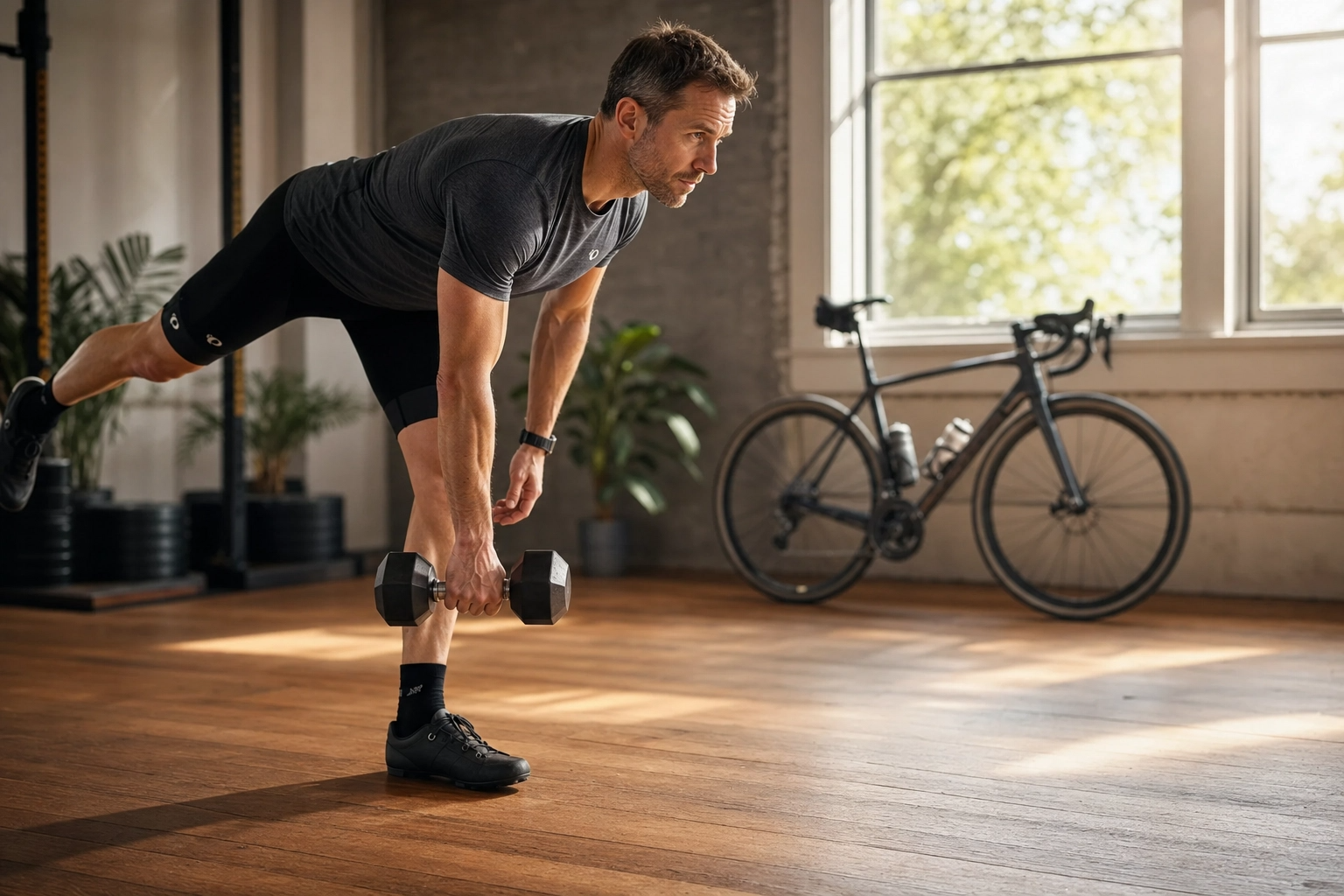
An indoor backup is not a defeat. It is a way to protect the next clear-air ride. Image illustration: AvidCyclist.
For cyclists, a smoke-and-heat backup can be deliberately simple: an easy indoor spin, short mobility work, strength, a swim, a recovery walk in a cleaner indoor environment, or rest. The goal is not to replicate every outdoor session. The goal is to preserve routine without compounding exposure.
If you track heart-rate variability or recovery metrics, use them as a cue for reflection—not as a reason to override public-health conditions. AvidCyclist’s primer on HRV is useful context: no single metric can replace sleep, symptoms, weather, and common sense.
The Route Is Part of the Risk
On a clear morning, a long remote loop can feel like freedom. During smoke and heat, it can become a trap.
The routes that deserve extra caution are the ones that offer little shade, no water, poor cell service, long climbs, distant bailout points, or a commitment to finish with a headwind. The same goes for group rides that make it socially difficult to turn around. A rider who is worried about looking weak is more likely to ignore the very signs they would take seriously in someone else.
On marginal days—when an outing still appears reasonable based on current official information—choose the kind of route that gives you choices. Stay closer to cleaner indoor spaces, ride a short loop instead of a point-to-point route, avoid repeated all-out efforts, tell someone the plan, bring water, and agree in advance that anyone can turn back without debate.
Then keep checking. Smoke can move. Heat can build. The sky can change faster than a training plan.
The New Summer Skill Is Knowing When Not to Ride
Cyclists are experts at making a plan. We watch the forecast, layer for a descent, pack food, examine climbs, and calculate daylight. Smoke and heat require the same seriousness—and a little more humility.
The point is not to become anxious about every hazy sky. The point is to stop treating wildfire smoke and severe heat as ordinary variables. Check AirNow. Watch the heat forecast. Know your route and your exit. Listen to symptoms. Build a credible indoor alternative. And when the answer is no, make it a clean no.
The orange sky will clear. The route will still be there.
What matters is arriving at the next blue-sky morning healthy enough to enjoy it.
Your 60-Second Smoke-and-Heat Ride Check
1.Check current conditions and forecast: Use the AirNow Fire and Smoke Map for your route and return route; review local air-quality and heat alerts.
2.Decide before you kit up: Do not let preparation become a reason to ride through conditions you would otherwise avoid.
3.Match the plan to the risk: No hard intervals, remote epics, or long exposed climbs on a questionable smoke-and-heat day.
4.Carry an off-ramp: Choose a route with a quick return to clean, cool air—or do not start.
5.Respect symptoms: Stop early, cool down, and seek appropriate care for concerning, severe, new, or worsening symptoms.
Conditions change. This article is not a substitute for local public-health alerts or individualized medical advice. Before you ride, verify air quality and heat conditions for your exact route.