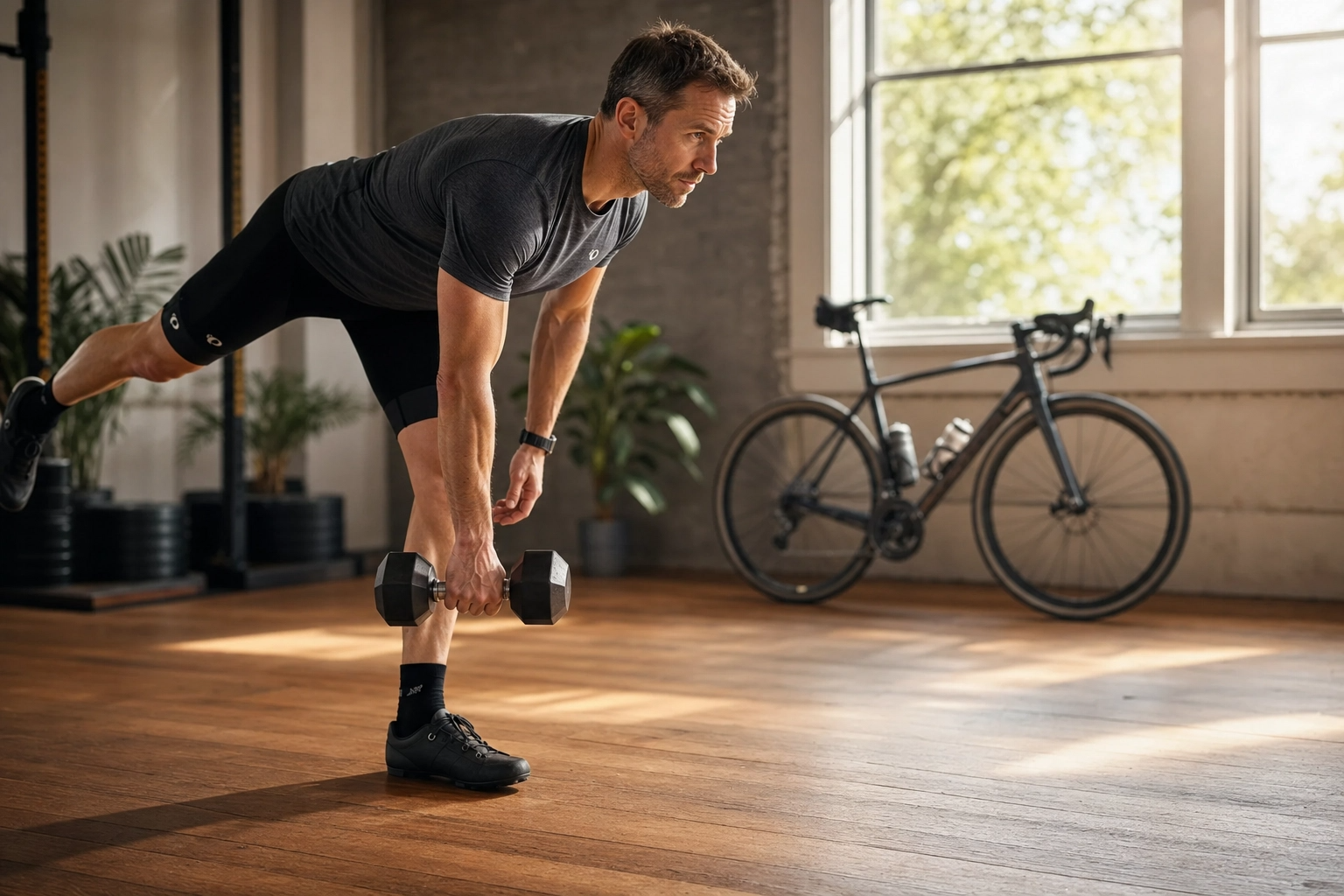
For years, the cycling world has treated strength training like a complicated math problem. Cyclists have obsessed over periodization schemes, time under tension, free weights versus machines, and whether training to absolute failure is necessary. The result? Most riders either skip the gym entirely or spend weeks researching the “perfect” plan before ever picking up a weight.
New science is here to cut through all of that noise. The American College of Sports Medicine (ACSM) recently published its first major update to resistance training guidelines in 17 years — and the headline finding is refreshingly simple: any resistance training improves strength, and the best plan is the one you will actually stick with.1
After analyzing 137 systematic reviews covering more than 30,000 participants, the researchers concluded that consistency matters far more than complexity. If you are a cyclist who has avoided the gym because it feels overwhelming or time-consuming, this is exactly what you need to hear.

Why Strength Training for Cyclists Is Non-Negotiable
Before diving into the plan itself, it is worth understanding why strength training is not just an optional off-season activity, but a critical component of year-round cycling performance and long-term health.
Strength Training Increases Cycling Power Output and Economy
Stronger muscles generate more force with each pedal stroke. Research published in the Scandinavian Journal of Medicine & Science in Sports found that a 12-week strength training program resulted in a 7.2% higher five-minute maximal power output at the end of three hours of cycling — compared to no improvement at all in the endurance-only control group.2 The mechanism is straightforward: when your muscles are stronger, they operate at a lower percentage of their maximum capacity at any given intensity, delaying fatigue and improving your overall cycling economy.
As we explored in depth in The Unspoken Advantage: Why Strength Training is a Game-Changer for Cyclists, strength training also improves neuromuscular coordination, allowing you to recruit more muscle fibers per pedal stroke and produce greater force with less perceived effort.
Strength Training Prevents the Most Common Cycling Injuries
Cycling is a repetitive motion sport. The same muscles fire in the same pattern thousands of times per ride, which leads to imbalances — particularly quad-dominance, weak glutes, and underdeveloped hip stabilizers. These imbalances are the root cause of the most common cycling complaints: knee pain, IT band syndrome, and lower back issues. Strength training corrects these imbalances by strengthening the connective tissues and stabilizing muscles that cycling alone neglects.3
Strength Training Preserves the Muscle You Need to Keep Riding
Cyclists are aerobically exceptional but often musculoskeletally underdeveloped. As we age, we naturally lose muscle mass and power — a process called sarcopenia — and cycling alone does not provide enough stimulus to prevent it. For riders over 40, this is particularly important. As discussed in Ride Away the Years: How Cycling Can Combat Aging’s Challenges, the athletes who continue riding strong into their 50s, 60s, and beyond are the ones who invest in their full-body strength.
What the New ACSM Guidelines Say About Strength Training
The 2026 ACSM Position Stand is the most comprehensive summary of resistance training science ever published. Here is what it means for cyclists, in plain language.4
| Old Belief | What the New Science Actually Says |
| You must lift to failure. | Training to absolute failure is not necessary for strength gains and may increase injury risk and fatigue, particularly for older or high-volume athletes. |
| You need a gym with machines and free weights. | Bodyweight movements, resistance bands, and simple dumbbells are equally effective. Equipment type does not significantly impact results. |
| Beginners need a completely different program. | The fundamental movements work for everyone, regardless of training experience. |
| Complex periodization is essential. | Simple, progressive overload — gradually increasing reps or weight over time — is just as effective as elaborate periodization for most adults. |
| You need to train five days a week. | Training at least twice a week is where significant strength gains begin. Two sessions per week is the cyclist’s strength minimum. |
“The best resistance training program is the one you’ll actually stick with,” says Stuart Phillips, distinguished professor of kinesiology at McMaster University and co-author of the Position Stand. “Training all major muscle groups at least twice a week matters far more than chasing the idea of a ‘perfect’ or complex training plan.”1
The Simplest Strength Plan for Cyclists: A 2-Day-Per-Week Template
Based on the new ACSM guidelines and cycling-specific research, here is a simple, evidence-based strength plan that any cyclist can follow — no personal trainer required.
The Ground Rules
Frequency: Two days per week (e.g., Tuesday and Thursday, or any two non-consecutive days).
Duration: 30 to 45 minutes per session.
Sets and Reps: 2 to 3 sets of 8 to 12 repetitions per exercise.
Load: Choose a weight or resistance that feels challenging by the last two reps of each set, but do not push to complete failure.
Timing: Perform strength work before your endurance ride on the same day, or on a separate day entirely, to ensure you have the energy to lift with proper form.
Progression: Every two to three weeks, add one repetition per set or a small amount of weight. This is progressive overload — the single most important principle in strength training.
The 5 Essential Strength Exercises for Cyclists
You do not need 20 different exercises. The following five movements target every major muscle group used in cycling, address the most common imbalances, and can be performed at home with minimal equipment.
- Goblet Squat (or Bodyweight Squat)
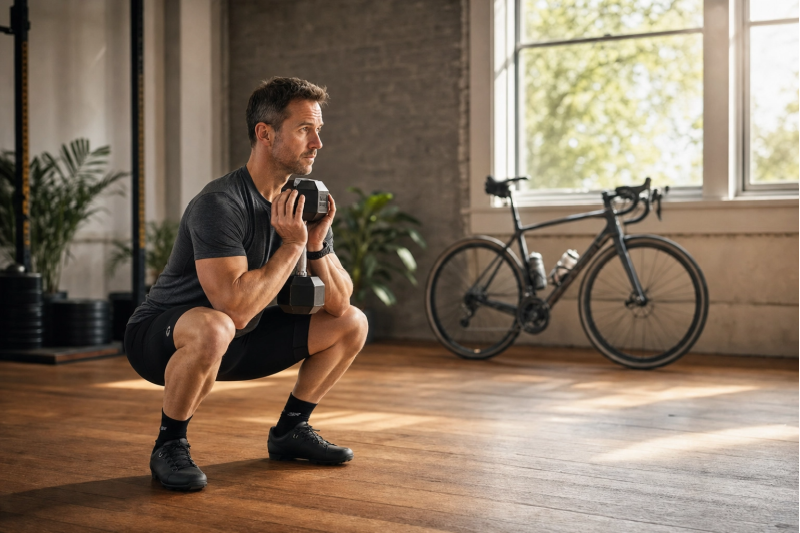
Muscles targeted: Quadriceps, glutes, core
The squat is the foundational lower-body exercise. It builds the leg and glute strength that directly powers your pedal stroke. Hold a dumbbell or kettlebell at your chest for added resistance, or perform the movement with bodyweight to start.
- Romanian Deadlift (RDL)
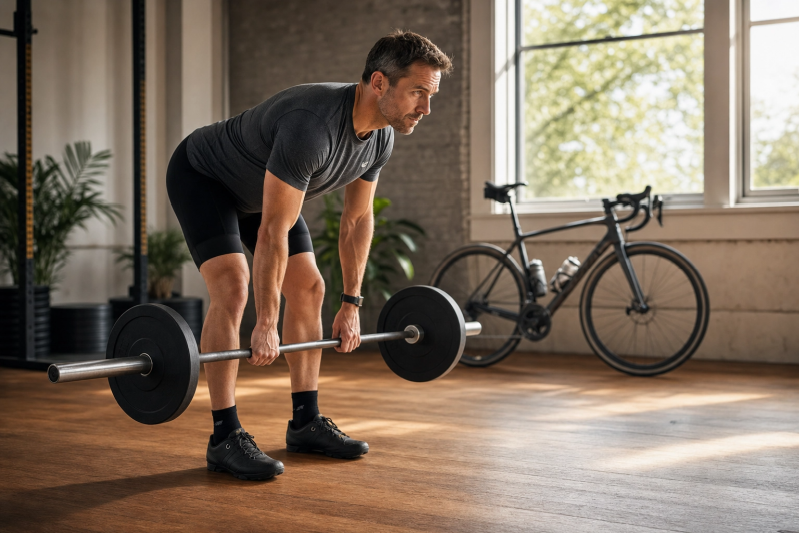
Muscles targeted: Hamstrings, glutes, lower back
Cyclists are notoriously quad-dominant. The Romanian deadlift corrects this imbalance by targeting the posterior chain — the hamstrings, glutes, and lower back — which are critical for climbing, sprinting, and maintaining a strong position in the saddle over long distances. Perform with dumbbells or a barbell.
- Reverse Lunge (or Bulgarian Split Squat)
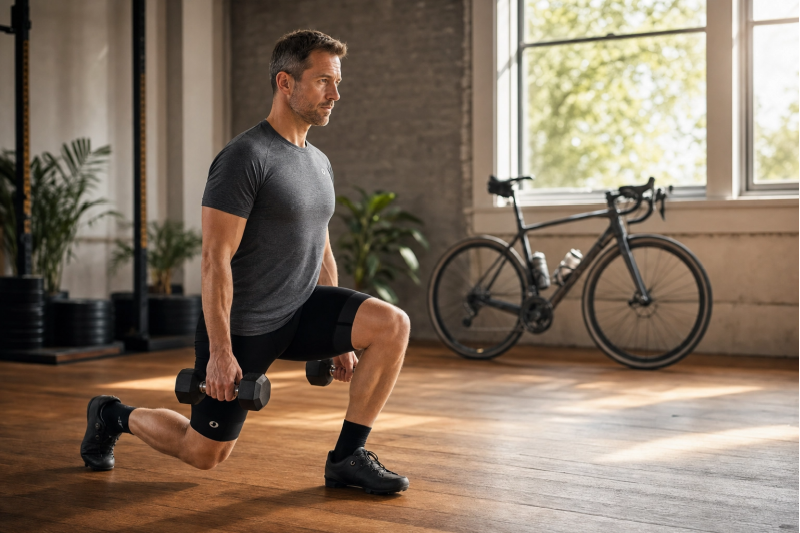
Muscles targeted: Glutes, quadriceps, hip stabilizers
Cycling is fundamentally a single-leg sport. Unilateral exercises like lunges build independent leg strength and expose and correct side-to-side imbalances, ensuring equal power transfer from both legs. The reverse lunge is gentler on the knees than a forward lunge, making it the preferred variation for most cyclists.
- Push-Up (or Dumbbell Chest Press)
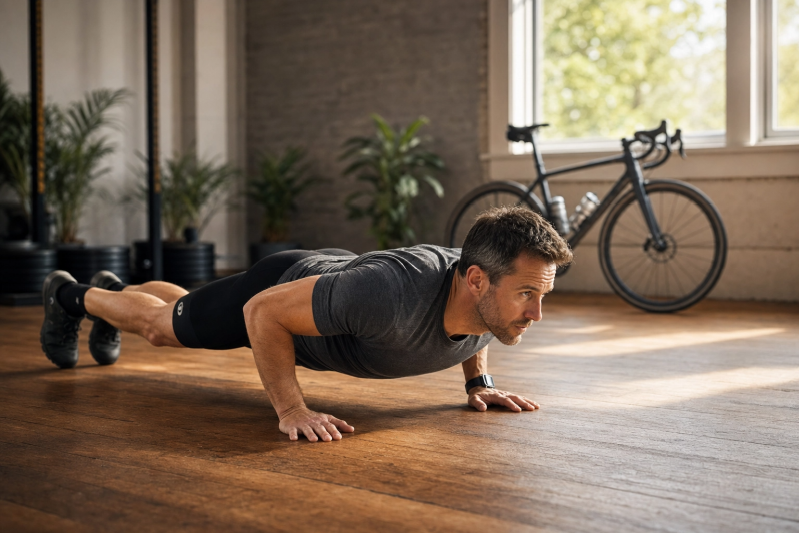
Muscles targeted: Chest, shoulders, triceps
A strong upper body helps you maintain a stable, aerodynamic position on the bike, absorb road vibration, and handle the bike confidently. Push-ups are a zero-equipment option; a dumbbell press on a bench or the floor adds progressive resistance as you get stronger.
- Plank (or Dead Bug)
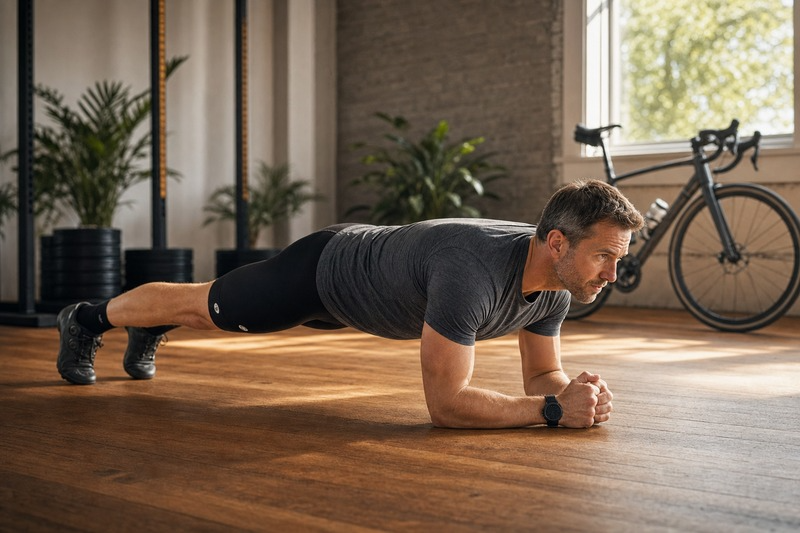
Muscles targeted: Core, transverse abdominis, lower back
A strong and stable core is the foundation of efficient cycling. It provides a solid platform for your legs to generate power and prevents the energy leaks caused by excessive movement in the saddle. Hold a plank for 20 to 45 seconds per set, or perform the dead bug for 8 to 10 reps per side for a more dynamic core challenge.
How to Integrate Strength Training with Your Cycling Schedule
The most common concern cyclists have about adding strength work is that it will leave them too sore or fatigued to ride. Managed correctly, this is rarely a problem.
During the off-season or base-building phase, prioritize your two strength sessions per week. This is the ideal time to build a foundation of strength, as your cycling volume and intensity are lower and your body has more capacity to recover from the added load.
During peak riding season, you can reduce to one session per week. The goal at this point is maintenance, not development. One well-executed session per week is enough to preserve the strength you have built without compromising your freshness for key rides. This is consistent with the approach outlined in From WODs to Watts: How CrossFit Forges Fitter, Faster Cyclists, where the recommendation is to scale back to one to two sessions per week during the competitive season.
It is equally important to respect your recovery. As covered in Cycling Recovery: Why Rest Days Are Just as Important as Training, your body grows stronger during rest, not during the session itself. Avoid scheduling a heavy strength session the day before a long ride or a key interval workout.
The Bottom Line on Strength Training for Cyclists
The new science from the ACSM delivers one clear, liberating message: you do not need a complicated, expensive, or time-consuming gym routine to become a stronger cyclist. Two sessions per week, five fundamental exercises, and a commitment to gradually increasing the challenge over time is all it takes.
The cyclists who will benefit most are not necessarily the ones who train the hardest in the gym. They are the ones who show up consistently, week after week, and make strength training a non-negotiable part of their routine — just like their long ride on Sunday.
Start simple. Stay consistent. The gains will follow.