If you ask most cyclists when the iconic Copper Triangle ride began, they will likely tell you the year 2000. The internet says so. The official timelines say so. But history, as it often does, has a way of smoothing over the gritty, chaotic, and brilliant details of the actual beginning. The true inaugural year of this legendary Colorado cycling event was 1999, and it was born not from a corporation or a nonprofit, but from the friendship and ambition of two men who are as woven into the fabric of American cycling as Lycra itself: Bob Shaver and Ray Hilliard.
Recently, I had the pleasure of sitting down with Bob and Ray to talk about the wild, unpredictable, and ultimately triumphant first year of the Copper Triangle. What emerged from that conversation was a story of friendship, bold vision, locked outhouses, a pirate cyclist, a woman unconscious on a bike path, and a ride that permanently changed the landscape of recreational cycling in the Rocky Mountains. It is a story that deserves to be told in full.
Two Legends, One Friendship
To understand the Copper Triangle, you first have to understand the men who created it. And to understand the men, you have to go back to a house in Capitol Hill, Denver, in the late 1970s.

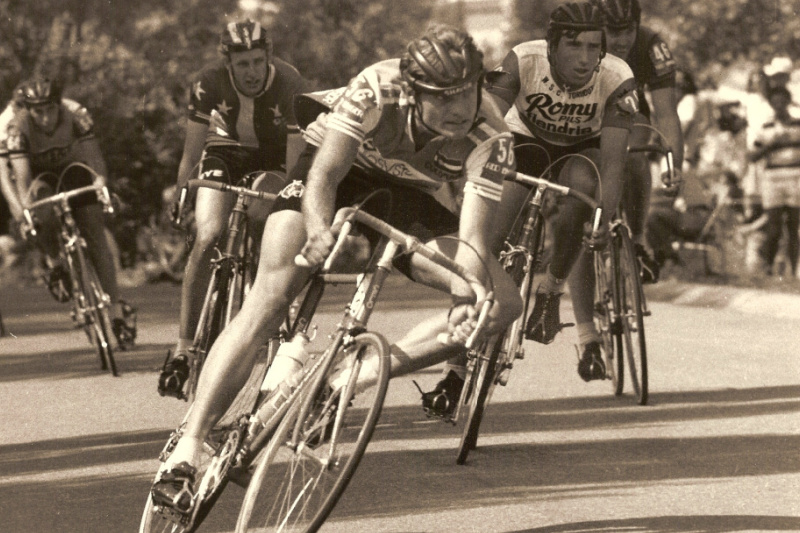
Bob Shaver is a cycling icon in every sense of the word. With over 200,000 miles in the saddle across a career spanning more than five decades, he has raced, advocated, inspired, and innovated at every turn. He is perhaps best known as the founder of ShaverSport Cycle Wear, the first company in the United States to use Lycra in cycling apparel — a development that would change the sport forever. He started the business in his basement, driven by a passion for the sport that began when, as a teenager, he watched his first bike race and was transfixed by the sound, the color, and the speed of it all. “I gotta do that,” he thought. And so he did.
ShaverSport’s fame extended well beyond the cycling community when Warner Bros. came calling for the 1985 film American Flyers, starring Kevin Costner. The studio needed cycling apparel for the film’s fictional team, and ShaverSport was asked to design and supply the gear. The result was the now-iconic blue ShaverSport jersey worn by the lead characters throughout the movie. “We were providing a lot of the wardrobing for a number of the teams,” Bob recalled. “The director came to us asking if we’d like our name on the lead actors.” It was a marketing masterstroke that introduced ShaverSport to an entire generation of cyclists and film lovers alike.
Ray Hilliard is an accomplished racer in his own right, a Category 1 competitor who built his reputation on the demanding roads and mountain passes of Colorado. He first encountered Bob in the late 1970s under circumstances that were, as he put it, “purely coincidental.”
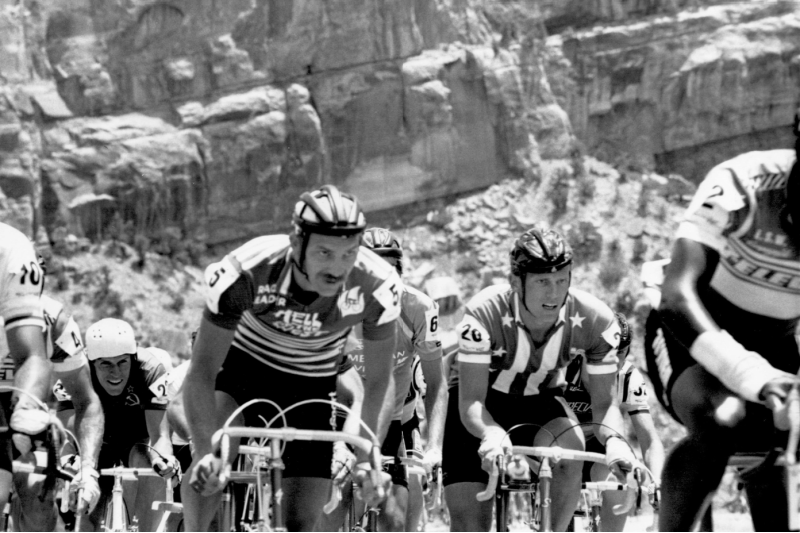
“The actual fact of the matter is that my mom had bought a house down in Capitol Hill in ’76 or ’77,” Ray explained with a grin, “and Bob, his full-time job was racing bicycles and a part-time job being a house painter. He was working on my mom’s house down in Capitol Hill, and I think that’s where we originally met.”
Being what he described as a “brash young Cat 4,” Ray wasted no time. He invited himself along on a couple of training rides with Bob. “Bob was a lot faster than I was, particularly in the mountains,” Ray admitted, laughing. “But we’ve done lots and lots and lots of riding since then.”
That chance meeting over house paint and bicycle wheels forged a friendship that would last nearly five decades and eventually produce one of the most celebrated cycling events in the country.
Later they would also share involvement in the hit cycling movie, American Flyers. While Bob was putting his jerseys on Kevin Costner, Ray found himself riding along side of him in many of the scenes.
The Idea: Mountains, a Loop, and Something Different
By the spring of 1999, Bob and Ray were ready to channel their shared passion into something bigger. They had been tossing around ideas for a cycling event, and they quickly ruled out putting on a traditional race. As Ray explained, “The problem with promoting a bike race is that you pay people. You have to come up with a prize list and give things away. And if you do one of these massed recreational rides, they pay you, so that seemed like a much better deal.”
But they were equally determined not to create just another Front Range ride. The Colorado cycling calendar already had plenty of those — events like the Elephant Rock ride in Castle Rock were popular, well-established, and flat. Bob and Ray wanted mountains. They wanted altitude. They wanted something that would make a cyclist feel the full, breathtaking weight of riding in the Colorado Rockies.
They also had a firm opinion about the format. The Triple Bypass, which predated the Copper Triangle, was a point-to-point ride — spectacular, but what Bob called “a death march” that left you a long way from your car at the end of the day. “We didn’t want to do a point-to-point like the Triple Bypass,” Bob said. “We wanted a circuit. A loop. Something unique.”
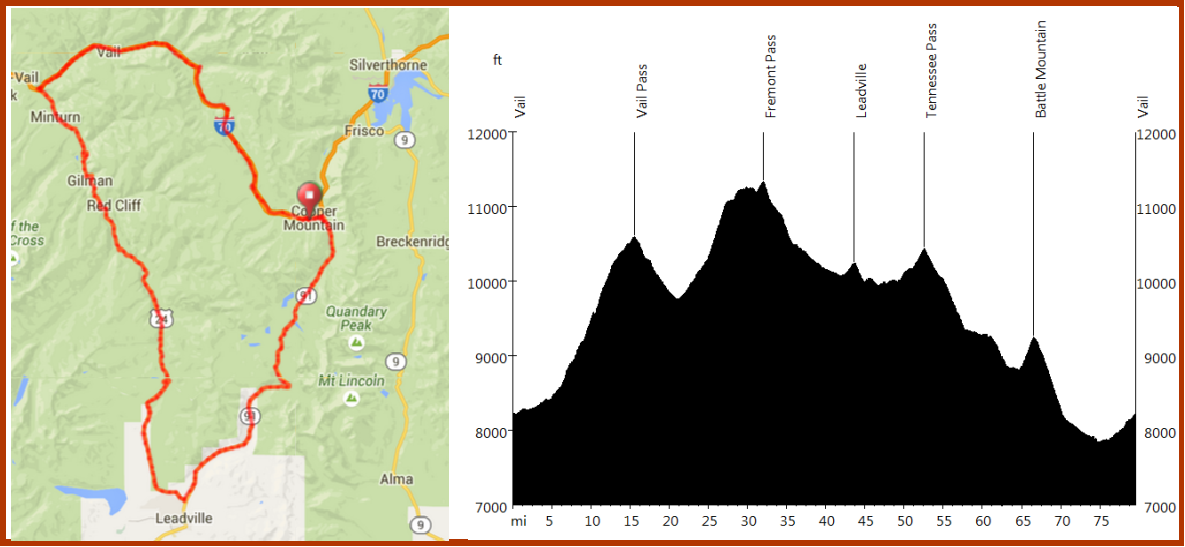
The solution presented itself in the form of a route that had been ridden informally by local cyclists for years: a loop from Copper Mountain up and over Fremont Pass, down to the Leadville area, across to Vail via Tennessee Pass, and back over Vail Pass to Copper Mountain. It was elegant in its simplicity and staggering in its ambition.
“It was at that point a pretty safe recreational ride,” Bob noted, walking through the route’s logic. “From Copper up to the top of Fremont Pass, there’s a big shoulder all the way up except for the last little bit. Then once you’re off the bottom of Fremont Pass, there’s a pretty good shoulder all the way down to Leadville. You don’t go into Leadville, but you turn off on Tennessee Pass, and that historically is not very heavily trafficked. And then from Dowd Junction, you’re on either a frontage road or a dedicated bike path all the way back over to Copper Mountain.
“We were looking for the quality of the ride,” Bob added, “and to not have a ‘me too’ event.”
The route covered approximately 79 miles and crested three passes — Fremont Pass at 11,318 feet, Tennessee Pass at 10,424 feet, and Vail Pass at 10,662 feet** — for a total elevation gain of roughly 6,500 feet. Three mountain ranges, three passes, and one unforgettable loop.
Building the Event: 200,000 Brochures and a Bold Bet
With the route chosen, the real work began. Bob and Ray had cycling knowledge and passion in abundance, but event management experience was another matter entirely. What they lacked in experience, however, they made up for in resourcefulness.
Their most significant marketing move was a partnership with Colorado Cyclist, one of the largest mail-order cycling retailers in the United States at the time, founded by Doug Bruinsma in 1979.
The plan was to insert a promotional brochure into the Colorado Cyclist catalog, which had a circulation of around a quarter of a million copies.
“It was an open-up brochure thing that got stapled in the center of the catalog,” Ray explained. “So we had to have like 200,000 of these things printed up for every catalog.” They tried to get the brochure distributed only to Colorado zip codes, but the logistics of the mailing operation made that impossible. “He said, ‘Okay, we’ll just do 200,000,'” Ray recalled. “And that was a little bit bigger expense than we expected.”
But Colorado Cyclist’s audience was discerning, and the brochure had to match the quality of the catalog it was riding in. The result was a four-color, slick-paper brochure — “breathtaking price-wise,” as Ray put it — but it worked. “That’s what made it happen,” he said.
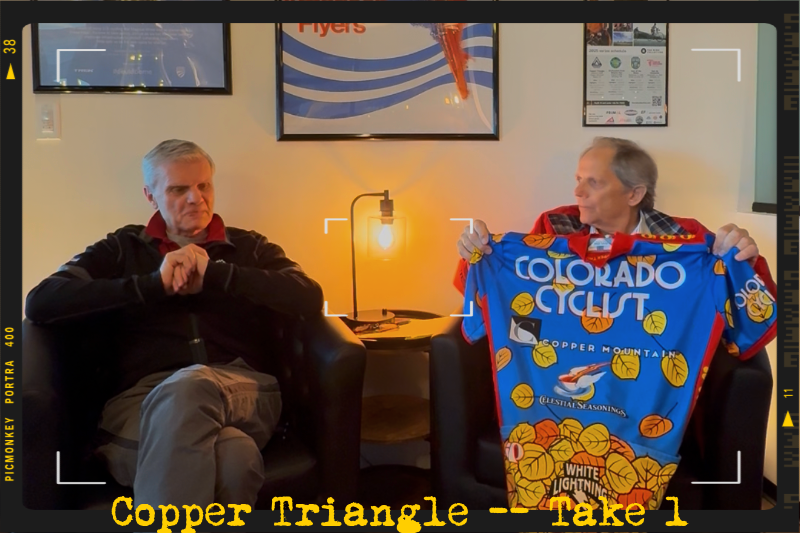
The jersey was another matter of considerable pride and complexity. Bob and Ray partnered with Pearl Izumi to produce a custom event jersey. The design featured falling aspen leaves cascading down the front — a nod to the Colorado autumn that perfectly captured the spirit of the ride. But getting the artwork right was an exercise in patience and precision.
“Getting this done correctly was kind of difficult,” Ray explained, “because Colorado Cyclist and Copper Mountain and White Lightning and Celestial Seasonings had logos that had to be sent in correctly in the right format for Pearl Izumi to work with. And then there would be some problems with the color reversal — like maybe this part of the Copper Mountain logo was white and it’s supposed to be reversed.”
Pearl Izumi, for their part, had their own requirements. “They told us that they wanted the side panels and they also wanted the shoulders — it had to say ‘Pearl Izumi,'” Ray recalled. “Which we didn’t necessarily have a problem with, but that was part of the deal at this pricing level. They wanted to maximize their brand.
Decades later, those original 1999 jerseys have become collector’s items. “We still see people out and about in these every once in a while,” Ray said with evident pride. A vintage 1999 Pearl Izumi Colorado Cyclist Copper Mountain jersey recently appeared for sale online, a tangible artifact of that inaugural year.
Race Day: Timex Clocks, Wristbands, and a European Touch
The first Copper Triangle was run as a mass-start event within a three-hour window — a format that gave it a European sportive feel. “We had a big Timex clock, like they used for swim meets,” Ray said. “It was so people could do it in the European method of timing. We even advertised it that way.”
Every registered participant received a wristband, which served as their entry credential. This detail would prove significant before the day was out.
One of the most important distinctions Bob and Ray had to maintain — with their insurance company, with local authorities, and in all their marketing materials — was that this was a recreational ride, not a race. “The first thing they were asking is, ‘Is this a race?'” Ray recalled. “It was critical that we made that distinction. We never used the word ‘race’ in any of the materials.”
Of course, as any cyclist knows, the competitive spirit is nearly impossible to suppress entirely. Ray offered one of the day’s best lines on the subject: “I always joke that every ride is a no-drop ride until the second guy shows up.”
The Stories That Made the Day
No inaugural event is complete without its share of memorable moments, and the first Copper Triangle delivered in full.
The Pirate. On the descent off Battle Mountain, one rider crashed into a road sign. When officials went to check on him, they discovered he had no wristband. He was, as Ray put it, “a pirate” — someone who had joined the ride without registering. “All the participants had a wristband, which is how they got into the race,” Ray explained. “He didn’t have one.” The incident was a reminder that even in the early days, the Copper Triangle was a ride people were willing to sneak into.
The Woman on Vail Pass. Ray had spent the day stationed at Dowd Junction, waiting until the last cyclist came through before heading back to Copper Mountain. Driving over Vail Pass, he spotted something alarming. “You know where maybe a mile or two miles below Black Lakes, the bike trail is right along the highway and you can see it? Well, there was a woman unconscious on the bike path.” Ray slammed on the brakes, backed up, and assessed the situation. “I think she had just gotten dehydrated and altitude sickness and kind of overdid it,” he said. He called the ski patrol at the top of Vail Pass, who came down and handled the situation. “But we didn’t have any major injuries,” he added. “Incredibly fortunate.”
The Outhouse Problem. Perhaps the most colorful logistical story of the day involved portable toilets. Bob and Ray had contracted a company out of Frisco to place outhouses along the route. At the top of Fremont Pass, there were already some outhouses — but they belonged to the highway department and were padlocked. The rental company’s representative offered some blunt advice: “If I was you, I’d drop a couple off here, because it’s going to piss people off if they think there’s your outhouses and they’re locked.” More outhouse rentals were added to the budget. “It sounds stupid to say,” Ray reflected, “but this was a whole lot more complicated than we imagined. And we figured it would be complicated, but it was more complicated.”
The Sponsors Who Said Yes Despite the logistical headaches, the generosity of sponsors was a genuine bright spot. White Lightning, the chain lubricant brand, donated hundreds of bottles. Nature Valley sent cases of granola bars. Copper Mountain Resort contributed discounted lodging passes and lift tickets. Goodie bags were assembled for the first registrants, and a proper sit-down meal was planned for the finish. “Everybody was happy,” Ray said. “That was always good.”
The event’s premium feel was intentional and, for the time, quite bold. “This was a pretty unique event for the time,” Ray noted, “and particularly charging what would be considered quite a bit of money back then. Everybody gets a jersey, and there’s a real sit-down meal at the end of the ride. It’s not just orange slices and granola bars.”
The Finish Line: Relief, Religion, and Grateful Wives
When the last rider came in and the final meal was served, the emotion that Bob and Ray both described was the same: relief. “That’s when you find religion,” Ray said, laughing.
Bob added, with characteristic wit: “And our four wives. Who did we marry, these two clowns?”
The Colorado Cyclist representative, for his part, was “over the moon” with the results. “He was just wanting to continue,” Ray said. “It went so well, and the turnout was good, and he overheard such positive [feedback].”
But Bob and Ray knew, even in that moment of triumph, that the event had outgrown them. “It was definitely successful,” Ray said, “but it needed somebody to take it over like Scott Harris, who did this for a living.”
Passing the Torch: Scott Harris and a Lasting Legacy
Scott Harris was the perfect successor. The founder of the Elephant Rock cycling event in Castle Rock — one of the most popular recreational rides in Colorado — Harris had built an entire career around organizing large-scale cycling events. He had the infrastructure, the relationships, and the hard-won experience that Bob and Ray had discovered was absolutely essential.
“He didn’t have to duplicate anything,” Ray explained. “He would just call the insurance company and say, ‘Okay, I’m adding a ride with this many riders.’ And he knows how to deal with the local constabulary. He’s just got a formula.”
The contrast with the first year’s experience was stark. “Bob and I went around in circles and circles,” Ray recalled. “How many packets of Pop-Tarts do we need at the rest stops? How many gallons of water? How many people do we really think are going to do the banquet afterwards? That’s where somebody like Scott Harris has got a lot of experience.”
Under Harris’s stewardship, the Copper Triangle grew steadily. By its 10th anniversary in 2015, the event was attracting approximately 3,200 riders and had become a signature fundraiser for the Davis Phinney Foundation, raising over $1 million for Parkinson’s disease research and support programs. Today, the event is managed by The Ride Collective and is scheduled for August 1, 2026, with registration open for up to 2,500 riders.
The route remains essentially unchanged from the one Bob and Ray mapped out in 1999 — a tribute to the elegance of their original vision. Three passes, three mountain ranges, one unforgettable loop.
A New Chapter: The Ride Collective
The Copper Triangle’s most recent chapter began in February 2023, when The Ride Collective — a new company founded by veteran event directors Scott Olmsted and Chandler Smith — acquired the event from Outside Interactive, Inc. (formerly known as Outside, Inc.), which had itself taken ownership of the ride after financial challenges had threatened its future.
Olmsted and Smith brought with them a combined forty years of experience managing cycling events across the Rocky Mountain West, having spent the previous four years running the Outside Events Cycling Series, which included the Copper Triangle alongside other beloved Colorado rides.
As of 2026, ownership passed to Conner Ratte, long time event manager, and formally with Gemini Adventures. He brings a youthful excitement and enthusiasm to the event, with fresh ideas while keeping with the traditions that made this and all of The Ride Collective events sore above the rest.
The Ride Collective is not simply a management company — it is, as its founders describe it, a philosophy. The organization operates a portfolio of eight professionally-produced road, gravel, and mountain bike events in both Colorado and New Mexico, ranging from the red rock canyons of the Colorado National Monument (Tour of the Moon) to the high desert of northern New Mexico (Enchanted Circle) and finishing the season with the wine country ride, Tour de Vineyards.https://www.theridecollective.com/enchantedcircle
At its core, the TRC approach is built around inclusion, community, and the idea that a great cycling event should offer something meaningful both on and off the bike. Events range from 500 to 2,000 participants, and the organization has committed to a Youth Development Program that allows riders 16 years old and younger to participate in road rides and gravel races free of charge — a nod to the belief that the next generation of cyclists deserves every opportunity to fall in love with the sport.
For the Copper Triangle specifically, The Ride Collective has maintained the soul of what Bob Shaver and Ray Hilliard originally built: a challenging, beautifully supported, non-competitive recreational ride that treats every participant to an experience far beyond orange slices at a rest stop.
The Davis Phinney Foundation partnership remains intact, ensuring that every registration contributes to Parkinson’s disease research and support — a cause that has become as inseparable from the Copper Triangle’s identity as the three passes themselves. “The only thing I love more than riding my bike is watching a new cyclist cross the finish line at an event like Copper Triangle,” said Robin Thurston, CEO of Outside, at the time of the acquisition — a sentiment that The Ride Collective has clearly carried forward.
With 2026 registration now open at The Ride Collective, and the event set for August 1, 2026 at Copper Mountain Resort, the ride that two friends dreamed up over a house-painting job in Capitol Hill, Denver, is as vibrant and relevant as ever.
The Bigger Picture: Why This Story Matters
The Copper Triangle is, on one level, a 79-mile bike ride over three mountain passes in Colorado. But on another level, it is a story about what happens when two people who love cycling decide to share that love with the world.
Bob Shaver spent his life doing exactly that — from racing on Colorado’s roads in the 1970s to introducing Lycra to American cycling apparel, from supplying the jerseys for a Hollywood film to organizing a ride that would become a cornerstone of the Colorado cycling calendar. His friend and collaborator Ray Hilliard brought competitive racing experience, sharp wit, and the kind of practical wisdom that comes from decades of riding hard roads.
Together, they built something that neither of them could have fully anticipated: a ride that would grow from a first-year experiment in 1999 into an event that draws thousands of cyclists from across the United States and beyond, raises millions for Parkinson’s research, and remains one of the most beloved cycling experiences in the American West.
“In retrospect, it was really cool,” Ray said, reflecting on that first year. “And there was a lot of creative enjoyment.”
That creative enjoyment, it turns out, has a very long shelf life.
The Copper Triangle 2026: Key Details
| Detail | Information |
| Date | Saturday, August 1, 2026 |
| Start/Finish | Copper Mountain Resort, Colorado |
| Distance | 79 miles |
| Elevation Gain | 6,500 feet |
| Passes | Fremont Pass (11,318′), Tennessee Pass (10,424′), Vail Pass (10,662′) |
| Charity Partner | Davis Phinney Foundation for Parkinson’s |
| Registration Limit | 2,500 riders |
| Registration | BikeReg.com/coppertriangle |
| Event Website | TheRideCollective.com/coppertriangle |
By Gary Robinson, AvidCyclist.com
Gary Robinson is the founder and CEO of Avid Cyclist (AvidCyclist.com), a nationwide platform for cycling news, advocacy, and community. A lifelong cyclist and racer, Gary has competed for various teams throughout Colorado and is a passionate advocate for cyclist safety.