If you are looking for the fountain of youth, you might want to stop looking in the supplement aisle and start looking in your garage.
For years, we have known that regular cycling provides immense health benefits, from weight management to improved joint health. But a massive wave of new scientific research published in 2025 and 2026 has revealed something far more profound: cycling does not just keep you fit. It fundamentally alters the way your body and brain age.
From unlocking your endurance on a weekend century to simply commuting to work, riding a bicycle is now being recognized by researchers as one of the most powerful anti-aging interventions available to humans.
Here is the latest science on how cycling adds years to your life — and life to your years.
The 10-Year Japanese Longevity Study
One of the most compelling pieces of evidence comes from a decade-long study published in 2025 in the journal Transportation Research. Researchers at the University of Tsukuba in Japan tracked 6,385 older adults over a 10-year period to see how bicycle use impacted their lifespan and independence.
The results were staggering. Older adults who cycled regularly had a significantly lower risk of requiring long-term care and a lower risk of premature death compared to those who did not cycle .
Perhaps the most encouraging finding for late bloomers? The researchers found that individuals who started cycling during the study period saw the same protective benefits against requiring long-term care as those who had been riding for years . It is definitive proof that it is never too late to rediscover the joy of cycling.
Your Brain on Bikes: 22% Lower Risk of Alzheimer’s
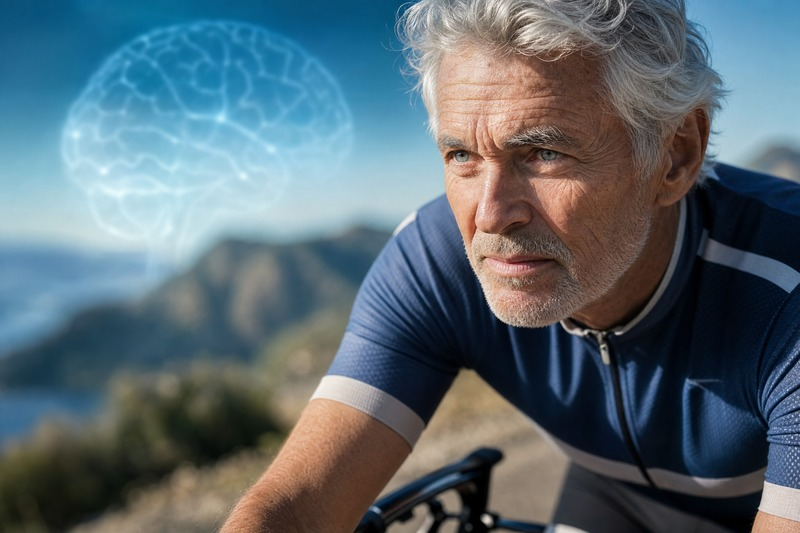
While the cardiovascular benefits of cycling are well documented, its impact on the brain is just now coming into focus.
In June 2025, a landmark study published in JAMA Network Open analyzed data from nearly 480,000 people over 13 years . The researchers wanted to know if “active travel” — walking or cycling — had an impact on dementia risk.
The data revealed that individuals who used cycling as their primary mode of transportation had a 19% lower risk of all-cause dementia and a 22% lower risk of Alzheimer’s disease compared to those who drove or took public transit.
Even more fascinating, brain scans showed that cycling was associated with minor increases in gray matter volume in the hippocampus — the region of the brain critical for memory .
This aligns perfectly with a massive May 2026 review of 87 studies published in Frontiers in Sports and Active Living. That review found that cycling consistently improves reaction time, attention, and cognitive performance .
“This review demonstrates that going for a bike ride can support everything from boosts in mood, to increases in social networks, to improvements in cognition.”— Lauren Schuck, Senior Research Manager at Outride
The Immune System of a 20-Year-Old
As we age, our immune system naturally declines. The thymus — the organ responsible for producing protective T-cells (white blood cells) — begins to shrink, leaving older adults more vulnerable to illness.
But a fascinating study from King’s College London found that cycling can halt this decline. Researchers biopsied the muscles and tested the blood of 125 highly active amateur cyclists aged 55 to 79.
They discovered that the cyclists were producing the same level of T-cells as adults in their 20s . In other words, decades of riding had preserved their immune systems, keeping them functionally decades younger than their biological age .
If you are a masters cyclist wondering how to balance this intensity, remember that tackling heavy legs and prioritizing recovery is just as important as the ride itself.
Mental Health and Stress Relief
In 2026, the World Health Organization (WHO) released a policy brief explicitly calling for the promotion of cycling and walking to combat the global mental health crisis .
The science of cycling and mental health is clear: aerobic exercise lowers stress hormones like cortisol and adrenaline while releasing endorphins . But cycling offers something unique. The combination of being outdoors, the required focus on balance and surroundings, and the rhythmic nature of pedaling creates a moving meditation.
For cyclists looking to maximize these benefits, focusing on Zone 2 training — a moderate, sustainable effort — provides immense aerobic benefits without the crushing physical stress that can elevate cortisol. Monitoring your Heart Rate Variability (HRV) can also help you ensure you are balancing your rides with proper nervous system recovery.
The Longevity Cheat Sheet
If you want to share the science of cycling with your non-riding friends and family, here is the cheat sheet of what the latest research proves:
|
The Science of Cycling
|
The Proven Benefit
|
|
Lifespan
|
Professional endurance cyclists live up to 8 years longer than the general population .
|
|
Brain Health
|
Regular cycling reduces the risk of Alzheimer’s by 22% .
|
|
Immunity
|
Cyclists in their 70s have the T-cell production of 20-year-olds .
|
|
Independence
|
Older adults who cycle are significantly less likely to need long-term nursing care .
|
|
Mental Health
|
Outdoor cycling consistently improves mood, reduces stress, and expands social networks .
|
The Ultimate Anti-Aging Pill
We spend billions of dollars every year on anti-aging creams, longevity supplements, and biohacking protocols. But the most effective tool for extending your healthspan is likely sitting in your garage right now.
It doesn’t require a prescription. It doesn’t require a doctor’s visit. You don’t even have to ride fast. You just have to pedal.