By Gary Robinson— Colorado Avid Cyclist
“It puts the lotion on the skin…” Most of you will recognize that line from Silence of the Lambs. It was pointed out because if the killer dehumanizes the victim, there is no empathy.
There is a sickness spreading across American roads, and it is not merely the familiar dangers of distracted driving or speeding. It is something more deliberate, more calculated, and in many cases, more sociopathic: a targeted, visceral, and increasingly violent hatred directed at a specific group of people — cyclists. This phenomenon, which could aptly be called Cyclist

Derangement Syndrome, manifests in road rage, intentional violence, and a disturbing volume of hateful rhetoric on social media. When a cyclist is killed, the tragedy is frequently met not with empathy, but with victim-blaming, mockery, and outright celebration. To understand this syndrome, we must examine the psychology behind it, the myths that fuel it, the legal disparities that enable it, and the media framing that normalizes it.
Part I: The Dehumanization of Cyclists — A Documented Phenomenon
On October 12, 2024, at the intersection of Hwy 83 and Jones Road in Douglas County, Colorado, a 55-year-old man was killed and another injured. They were not riding at the time. They were stopped at the intersection, on the inside of the southwest corner, waiting to cross. A truck heading south on Hwy 83 swerved to avoid a head-on collision with another vehicle and struck both men from the side. One died. One survived. The crash is still under investigation.
Within hours, a local news agency posted a six-sentence story about the incident. The story was incomplete, factually shallow, and failed to capture what actually happened. But that did not stop the comments from pouring in. What followed was not grief, not shock, not even indifference. It was hatred.
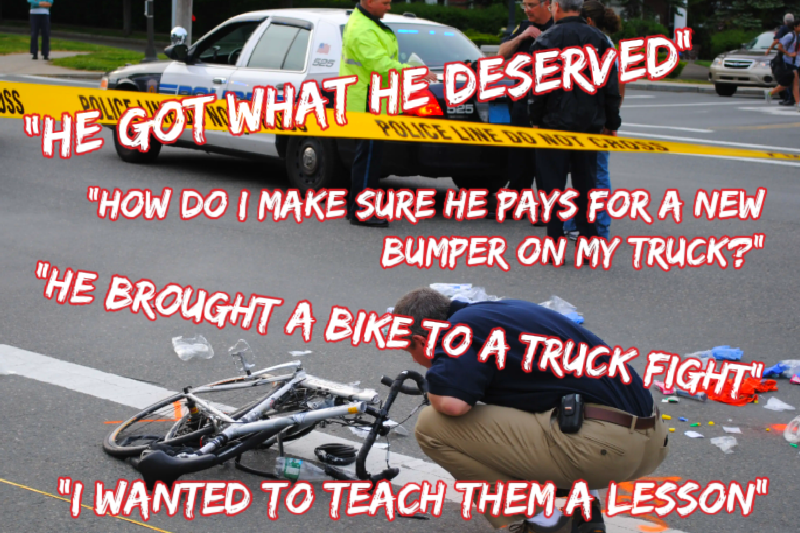
“Cyclists should not be on the road, he got what he deserved.”
“Enough is enough, ban bicycles now they are clearly to dangerous.”
“Brought a bike to a truck fight”
“adults playing with toys in the roads.”
“So is that worth extra points when hit more than 1?”
“One less liberal on the road”
“Sadly how many more accidents like this have to happen before they are removed from riding on the roads.”
These were not the comments of a fringe minority. They were among hundreds of similar posts made within 48 hours of a story that did not even accurately describe what had happened. The men who were struck were not recklessly riding in traffic. They were standing still. And still, the internet’s response was to celebrate their suffering.
This is not an isolated incident. It is a pattern. And it has a name.
The Science of Dehumanization
A landmark 2019 study published in Transportation Research Part F: Traffic Psychology and Behavior, led by researcher Alexa Delbosc at Monash University in Australia, applied two validated dehumanization measures to cyclists for the first time.
The findings were alarming. More than half of non-cyclist car drivers view cyclists as “less than fully human.” The study found a direct correlation between this dehumanization and self-reported aggressive behavior toward cyclists on the road.
On-road cyclists are particularly vulnerable to this psychological phenomenon. They look and move differently from typical road users. Their faces are often obscured by helmets and sunglasses. They occupy a liminal space in the motorist’s mental landscape — not quite a pedestrian, not quite a vehicle, not quite a person. This ambiguity makes it easier for drivers to strip away empathy and assign cyclists to a sub-category of road user that is seen as less deserving of consideration, safety, or even life.
As Gary Robinson, Editor of Colorado Avid Cyclist, observed after the Douglas County crash: “As soon as a man or woman on a bike is involved in a crash, he or she is no longer a human being. He or she is a ‘cyclist’ and is labeled.”
Part II: The Social Media Cesspool — Rhetoric That Would Shock a Decent Society
The comments following the Douglas County crash were not unique. They were typical. Across Facebook, Twitter/X, Reddit, and local news comment sections, the pattern repeats itself with disturbing regularity. After every cyclist death, after every crash, after every news story involving a bicycle, the same rhetoric emerges.
“He Got What Was Coming to Him”
When a cyclist is killed, a segment of the driving public does not mourn. They celebrate. Comments like “he got what was coming to him,” “he brought a bike to a truck fight,” and “cyclists don’t deserve to be on the road” are not rare outliers — they are commonplace. A post by the Douglas County Sheriff’s Office regarding a group of cyclists traveling four or five abreast (which was, admittedly, improper) generated over 1,200 comments in 72 hours. More than 90% of them were, in Robinson’s words, “pure hatred.” Comments ranged from “a snowplow from behind will take care of that” to “looks like bowling pins to me” and “Bowling for Cyclists”.
More disturbing, many of these comments came from people that looking at their social media profiles, would see them as regular people, family members, including 2 County Sheriff officers, and many members of a county wide group of “dads” that profess their family values and commitment to being great parental models. But give them a keyboard, and it becomes a different image.
In one crash where a cyclist was laying in the street in Castle Rock, CO, the driver took pictures of the cyclist he hit, posted on social media while paramedics were working to transport him to the hospital, asking the aforementioned “Dads” group “who should I call to make sure he pays for the damage my bumper?”. Later he was found responsible for the crash and all injuries to the cyclist.
These are not hyperbolic expressions of frustration. They are expressions of a desire to see human beings physically harmed. When the target is a cyclist, this language is tolerated, laughed at, and shared. Imagine the same comments directed at any other group of people. They would be removed immediately and likely reported to law enforcement.
The Political Tribalization of Cycling
In recent years, a particularly bizarre dimension has been added to the anti-cyclist rhetoric: the assumption that all cyclists are political liberals. This is a strange and revealing leap of logic. Cycling is a mode of transportation and recreation practiced by people across the entire political spectrum — from conservative ranchers who ride mountain bikes to progressive urban commuters. Yet in the current cultural climate, particularly in rural and suburban America, the sight of a cyclist in spandex on a road bike has become, for some, a symbol of coastal elitism, environmentalism, and left-wing politics.
This politicization serves a dangerous function: it transforms a human being on a bicycle into a political enemy. And in a polarized society, political enemies are not afforded the same empathy as fellow citizens. The result is that some drivers feel not just annoyed by cyclists, but ideologically justified in their hostility toward them.
Part III: From Words to Weapons — The Uptick in Intentional Violence
The dehumanizing rhetoric on social media is not merely offensive. It is dangerous. It creates a cultural permission structure for violence. And the evidence suggests that violence against cyclists is increasing.
Las Vegas, 2023: Murder on a Bicycle
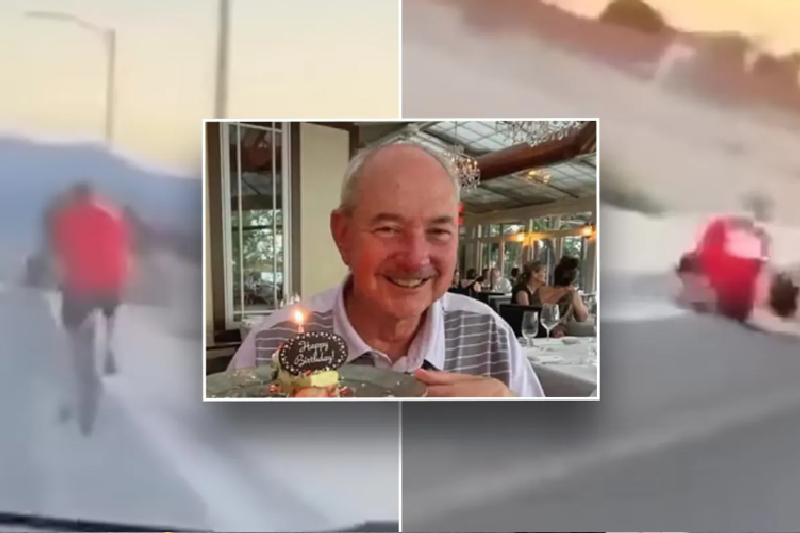
In August 2023, two teenagers in Las Vegas stole a Hyundai Elantra and went hunting. They struck a 72-year-old bicyclist, who survived, before targeting 64-year-old Andreas Probst, a retired police chief from Bell, California, who was riding his bicycle in a residential neighborhood. One of the teens filmed the attack on his phone. In the video, they can be heard laughing and saying “hit his ass” before the car plowed into Probst, killing him.
When the driver, Jesus Ayala, was arrested hours later, he told police: “You think this juvenile [expletive] is gonna do some [expletive]? I’ll be out in 30 days, I’ll bet you. It’s just ah, [expletive] ah, hit-and-run — slap on the wrist.”
He was wrong about the sentence. In December 2025, Ayala, then 20, was sentenced to 20 years to life, and his accomplice Jzamir Keys to 18 years to life.
But the casual confidence of that initial boast — the assumption that killing a cyclist would carry no serious consequence — speaks volumes about the cultural environment in which these young men were raised.
Boulder, Colorado 2023: Lies Upon Lies To Make A Driver That Killed A Cyclist Into A Victim
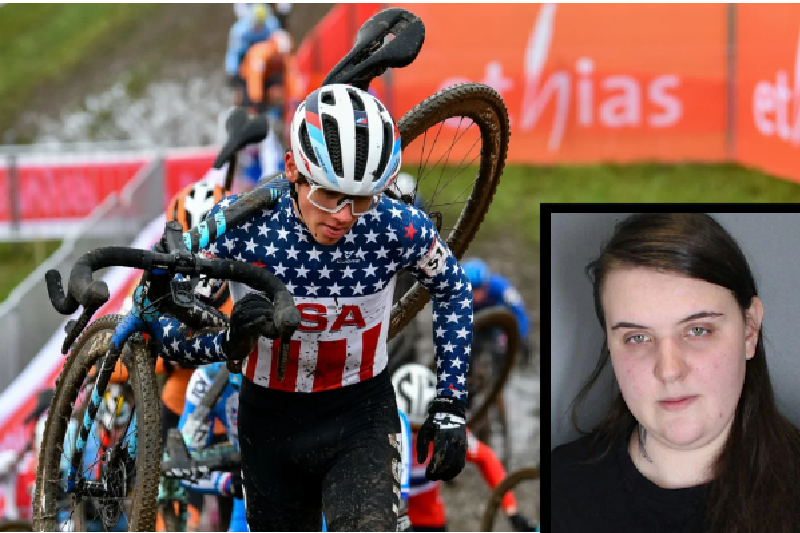
On July 29, 2023, Magnus White, a 17-year-old member of the USA Cycling National Team, was training for the UCI Mountain Bike World Championships in Scotland — a race he had dreamed of since he was a child in sixth grade. He was riding southbound on Highway 119 in Boulder County, known as the Diagonal, on the paved shoulder, 15 minutes from home, when a Toyota Matrix driven by 24-year-old Yeva Smilianska crossed from the travel lane into the shoulder and struck him from behind. Magnus was ejected from his bike and landed 60 feet away. He was transported to a hospital, where he died.
What followed was not simply a tragedy. It was a cascade of deception, institutional failure, and a social media backlash that turned the grieving parents of a dead child into targets.
In addition to other lies told by Smilianska that were revealed at trial, She and her attorney had described her as a Ukrainian War Refugee. The implication was clear: here was a vulnerable young woman, displaced by war, who had made a tragic mistake. Sympathy poured in for the driver. And when Michael and Jill White, Magnus’s parents, pressed forward with the prosecution, a segment of the public turned on them.
They received hate mail. They were attacked on social media. People who had never met their son, who knew nothing of Magnus’s life or the evidence against his killer, wrote to tell them they were being cruel — that they were persecuting a war refugee over an accident. The Whites, who had watched their son take his last breath in a hospital room, who had given a gentle nod to a doctor to authorize the removal of life support, were told by strangers that they should show more compassion.
The refugee claim was a lie. Prosecutors obtained Smilianska’s permanent resident card, which showed she had become a U.S. legal resident in 2017 — five years before the Russian invasion of Ukraine began in 2022. She had been living in the United States, working as a bartender in Longmont, Colorado, for years before the war she claimed to have fled. The bar was where she was drinking the night before she killed Magnus, until 3am. After that, staying up all night to drink more, take prescription drugs, and use cocaine, capturing the moment on video before taking Magnus’s life
Another cruel example of how driver tries to become the victim with aid of a defense lawyer, never allowing the parents of child to grieve their son.
Georgia, 2026: “I Did It to Teach You a Lesson”
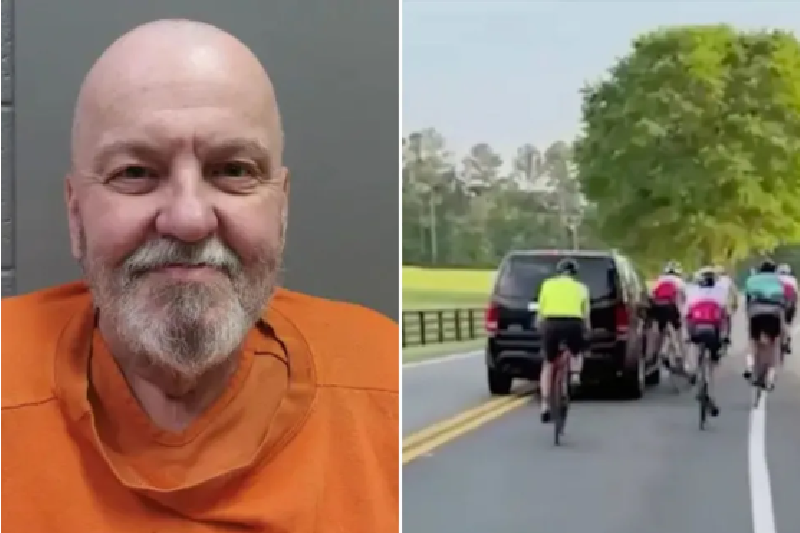
In April 2026, a driver in Cherokee County, Georgia, approached a group of 10 cyclists from behind, began honking, then accelerated and deliberately struck two of them. When confronted by police, the driver admitted that he had intentionally hit the cyclists “to teach them a lesson that bikes don’t belong on roads.” This admission was recorded in the police report.
The driver, 72-year-old Jerry Wayne Ross, was arrested and charged with aggravated assault. He was photographed smirking in his mugshot.
The internet’s reaction to this story was, predictably, divided. Many were outraged. But a significant portion of commenters expressed sympathy for the driver, or at least understanding of his motivation. “Bikes don’t belong on roads” was repeated in comment after comment, as if the driver’s stated motive was a legitimate legal defense.
Timnath, Colorado, 2023: A Ten-Year-Old Boy, a Texting Driver, and a Ghost Bike Taken Down to Spare Her, The Driver’s, Feelings
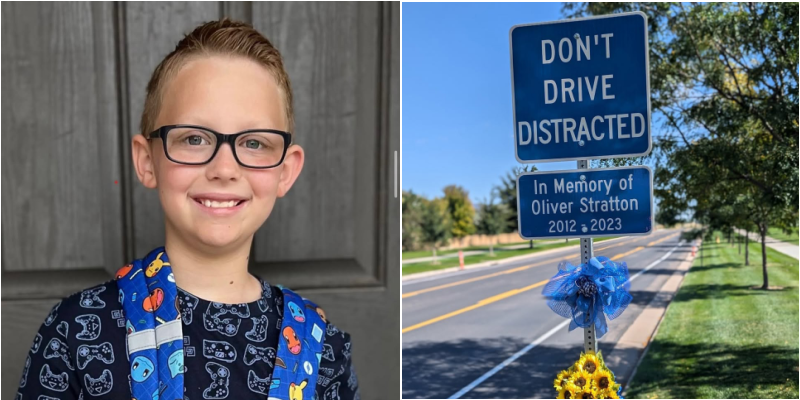
Of all the cases that illustrate the depth of Cyclist Derangement Syndrome — not just in the act of killing, but in the aftermath — none is more heartbreaking than the death of Oliver “Ollie” Stratton.
On August 2, 2023, Ollie Stratton, a 10-year-old boy from Timnath, Colorado, was riding his bicycle near his home when he was struck by a 2019 Audi SUV driven by Amy Weiss, a 53-year-old middle school math and science teacher. Ollie was transported to a hospital, where he died the following day.
The investigation, exposed at trial, revealed that Weiss had been texting for more than 30 minutes during her drive from Fort Collins to Timnath, and had sent a text message in the seconds immediately before the crash.
In the moments after she struck Ollie — while he lay gasping for breath in the road — Weiss did not call 911. Instead, she called Tyler Drage, a deputy fire chief, and then she began deleting the texts from her phone and manually locking the device.
Drage testified at trial that he performed a “two-hand cervical spine stabilization hold” on the injured boy. However, video evidence showed he used only one hand — because with the other, he was calling his own wife to come quickly, because his friend Amy Weiss was in distress
Ollie Stratton was dying in the street. The priority, for both the driver and the first responder on the scene, was Amy Weiss.
Weiss was charged with Careless Driving Resulting in Death and Tampering with Physical Evidence. She lied about the texts. She lied about deleting them. She lied about the direction Ollie was traveling. After a week-long trial in December 2024, a jury found her guilty of Careless Driving Resulting in Death — a class one misdemeanor. Four days before the verdict, she had already pleaded guilty to Tampering with Evidence.
On March 7, 2025, Judge Ecton sentenced Amy Weiss to the maximum allowed under Colorado law:
- Count One — Careless Driving Resulting in Death: 365 days in jail, $1,000 fine (suspended)
- Count Two — Tampering with Physical Evidence: 364 days in jail, $1,000 fine (suspended)
The sentences were to run concurrently, with work release authorized.
In practice, Weiss served only months of that maximum one-year sentence.
District Attorney Gordon McLaughlin, who prosecuted the case, stated: “We need to change the culture where cellphone causing crashes are seen as ‘just an accident.’ They are lethal and the decision to use a phone while driving is intentional. I urge folks to think about Ollie and put their phones down.”
But the legal proceedings were only part of the ordeal endured by Ollie’s family. After his death, his parents, Clarissa and Rod Stratton, placed a ghost bike — a white-painted bicycle used as a roadside memorial — at the location where their son was killed. Ghost bikes are a recognized and widely practiced form of memorial for cyclists killed on the road.
Deputy Fire Chief Tyler Drage — the same man who had arrived at the scene and prioritized comforting Amy Weiss over stabilizing a dying child — led a campaign to have the ghost bike removed. He argued that it caused him emotional distress.
The Stratton family was forced to fight for over a year to keep the memorial in place. Eventually, the town of Timnath ruled that the ghost bike could not remain on the roadside. It was taken down. The ghost bike that memorialized a 10-year-old boy, killed by a texting driver, was removed — in part to spare the feelings of a man who had protected that driver at the scene, and the feelings of the woman that took his life, prioritizing her texting to human life.
The ghost bike now sits inside the Stratton family’s home.
This case encapsulates, in its entirety, the full arc of Cyclist Derangement Syndrome: the driver who considered her texts more important than the life of a child; the first responder who prioritized the driver over the dying boy; the legal system that treated the killing as a misdemeanor; and the community that moved to erase the memorial rather than confront the reality of what happened on that road.
Goodyear, Arizona, 2023: A Mass Casualty Event, a Misdemeanor Sentence
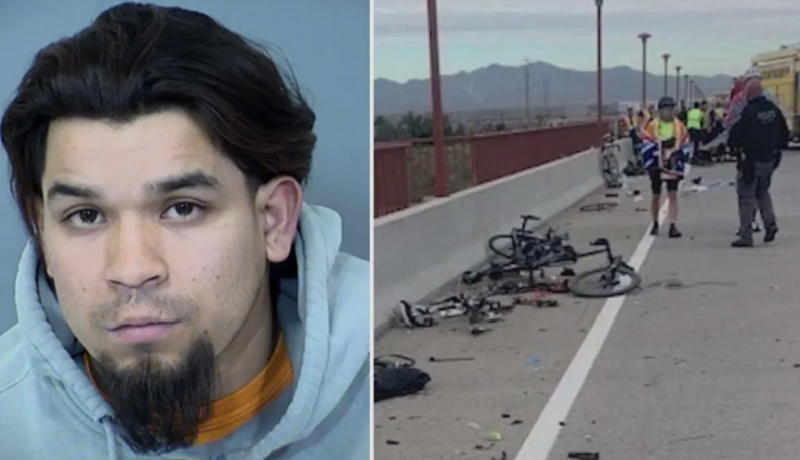
On February 25, 2023, a pickup truck hauling a trailer crashed into a group of 20 cyclists on the Cotton Lane Bridge in Goodyear, Arizona, a suburb of Phoenix. Two cyclists were killed: Karen Malisa, 61, of Goodyear, and David Kero, 65, of Michigan. Seventeen others were injured.
The driver, Pedro Quintana-Lujan, remained at the scene. Prosecutors found no evidence of speeding or alcohol impairment. After more than two years of legal proceedings, Quintana-Lujan pleaded guilty to 12 misdemeanor counts — two for causing death by moving vehicle, and ten for causing serious injury. He was sentenced to one year in jail, followed by three years of probation, a 180-day license suspension, 60 hours of community service, and a $2,500 fine.
Two lives taken. Seventeen people injured. One year in jail. Two thousand five hundred dollars.
The families of the victims were devastated, not just by the crash, but by the justice system’s response to it. Prosecutors declined to file felony charges because they did not believe they could secure a conviction. This is the legal reality that cyclists and their families face across America.
Littleton, Colorado, 2024: Liam Stewarts Loses His life, Driver Gets Probation
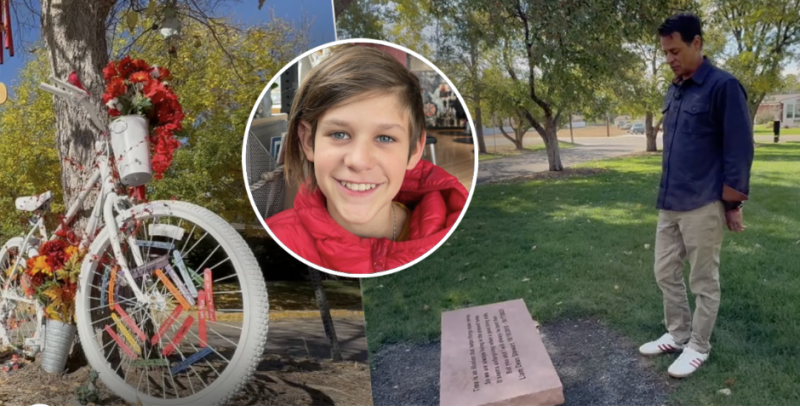
The case of Liam Stewart illustrates this painfully. Liam was a 13-year-old middle school student in Littleton, Colorado, who was struck from behind and killed while riding his bike to school on October 17, 2023. The driver, 39-year-old Beth Ann Hutchinson, plead guilty in February to a misdemeanor careless driving resulting in death charge.
According to the crash report, Hutchinson was going east on Arapahoe and Stewart was going north on Elati. Hutchinson hit Stewart while driving through the intersection at Elati, and indicated that she was unable to see because of the morning sunrise.
Liam’s father, Josh Stewart, has since become an advocate for stronger penalties, saying: “There’s no amount of punishment that seemed like it could balance what we were feeling.”
Part IV: The Legal Vacuum — When Killing a Cyclist Is Just a Misdemeanor
The Goodyear and Colorado cases are not anomalies. They reflect a systemic legal reality in the United States: in most states, killing a cyclist with a motor vehicle, absent clear evidence of intoxication or intent, is treated as a minor traffic offense.
In Colorado, the charge of “Careless Driving Resulting in Death” is a class one traffic misdemeanor. The penalty ranges from 10 days to one year in jail and fines between $300 and $1,000.
As attorney Brad Tucker, founder of ColoBikeLaw.com and a board member of Bicycle Colorado, wrote in a 2025 op-ed: “In Colorado, every state law treats the death of a person due to another’s actions as a felony — except one: hitting a person with a vehicle.”
Tucker continued: “When a driver kills someone with their vehicle and is charged with a misdemeanor traffic violation, it is hard to accept that this is what accountability looks like. I know most families who have lost loved ones will unequivocally say that drivers receive a slap on the wrist.”
In 2025, Colorado legislators introduced Senate Bill 25-281, which would increase the penalty for careless driving resulting in death from a class one misdemeanor to a class six felony, carrying up to 18 months in prison and a $100,000 fine. This bill was watered down and the felony portion was taken out. Those objections by legislators and defense attorneys argued that “on accident should not ruin the life of a defendant by labeling them with a felony. My question, and any normal person’s should be: “What about the life they took that never even had a chance?”
A summary of recent cases and results should be shocking.
| Incident | Victims | Driver Charge | Sentence |
| Oliver “Ollie” Stratton, Timnath, CO (2023) | 1 killed (age 10) | Careless driving (misdemeanor) + tampering with evidence | 365 days jail (concurrent), work release; served months |
| Liam Stewart, Littleton, CO (2023) | 1 killed (age 13) | Careless driving (misdemeanor) | 2 years probation, $1,000 fine |
| Goodyear, AZ cycling crash (2023) | 2 killed, 17 injured | 12 misdemeanor counts | 1 year jail, $2,500 fine |
| Magnus White, Boulder, CO (2023) | 1 killed (age 17) | Vehicular homicide (felony) | 4 years prison |
| Andreas Probst, Las Vegas, NV (2023) | 1 killed | 2nd degree murder | 18–20 years to life |
The contrast between the Probst case — where intent was clear and documented on video — and the Goodyear and Liam Stewart cases reveals the enormous gap in how the law treats intentional versus negligent killing of cyclists. But for the families left behind, the distinction between a driver who meant to kill and one who was simply careless enough to kill offers little comfort.
Part V: The Law They Don’t Know — Myths, Misconceptions, and the Idaho Stop
Perhaps the most infuriating aspect of the anti-cyclist rhetoric is the claim that cyclists routinely break traffic laws while drivers are paragons of road compliance. This claim is demonstrably false on both counts.
Cyclists Are More Law-Abiding Than Drivers
A study by the Danish Road Directorate, widely reported by Forbes and other outlets, found that less than 5% of cyclists break traffic laws while riding, compared to 66% of motorists.
A separate American study found that cyclists complied with traffic laws 88% of the time during the day and 87% at night, compared to a slightly lower compliance rate among drivers.
When cyclists do break laws, research shows they most commonly do so for their own safety — for example, proceeding through a red light at an empty intersection to avoid being struck from behind. Drivers, by contrast, most commonly break laws to save time.
Every day, on every road in America, drivers speed, roll through stop signs, run red lights, tailgate, and text while driving. These are not rare exceptions; they are the norm. According to federal data, nearly 700,000 police-reported motor vehicle crashes occur annually at stop signs, and approximately one-third involve injuries.
Yet the driver who speeds through a stop sign every morning on the way to work feels entirely justified in screaming at a cyclist for the same behavior.
The Idaho Stop: Legal, Safe, and Widely Misunderstood
One of the most common flashpoints for anti-cyclist anger is the sight of a cyclist rolling through a stop sign. Drivers frequently interpret this as lawbreaking. In many states, it is not.
The “Idaho Stop” law, first enacted in Idaho in 1982, allows cyclists to treat a stop sign as a yield sign: they must slow down, check for traffic, and may proceed without coming to a full stop if the intersection is clear. Many states have since adopted similar laws, including Colorado (2022), Oregon, Washington, Delaware, Arkansas, and New Mexico (2025), among others.
As of late 2025, more than a dozen states had enacted some form of the Safety Stop law.
Studies show that the Idaho Stop actually reduces intersection crashes. In Delaware, conflicts between cyclists and drivers at intersections went down 23% after the introduction of a stop-as-yield law.
The logic is straightforward: a cyclist who can maintain momentum through an intersection spends less time in the danger zone and is more visible and predictable to drivers.
Yet many drivers — and, critically, many police officers — are unaware of these laws. A driver who sees a cyclist legally yield at a stop sign may incorrectly assume the cyclist is breaking the law, and may respond with aggression, horn-honking, or worse. The ignorance is not the cyclist’s problem. It is the driver’s.
The Right to Use the Full Lane
Another common source of driver rage is the sight of a cyclist “taking the lane” — riding in the center or left portion of a traffic lane rather than hugging the right shoulder. Drivers frequently interpret this as arrogance or obstruction. In reality, it is often both legal and the safest course of action.
Under the laws of most states, cyclists are permitted to use the full lane when the lane is too narrow to be safely shared side-by-side with a motor vehicle — which is most lanes on most roads. The League of American Bicyclists notes that if a lane is not at least 14 feet wide, cyclists should ride in the center to prevent unsafe passing.
A cyclist who rides on the far right edge of a narrow lane is actually inviting drivers to squeeze past at unsafe distances, creating a far more dangerous situation.
Furthermore, 33 states and the District of Columbia have safe passing laws requiring drivers to give cyclists at least three feet of clearance when passing.
Many drivers are unaware of this requirement, and many who are aware of it routinely ignore it.
Part VI: The Tax Myth — A Red Herring Wrapped in Ignorance
“They don’t pay taxes, so they shouldn’t be on a road.” This comment, which appeared in the social media fallout after the Douglas County crash, is one of the most persistent and easily debunked myths in the anti-cyclist playbook.
The argument goes like this: roads are paid for by gas taxes and vehicle registration fees; cyclists don’t pay gas taxes or registration fees; therefore, cyclists have no right to use the road. Every step of this argument is wrong.
First, roads are not primarily funded by gas taxes and registration fees. According to the Victoria Transport Policy Institute, motor vehicle users pay an average of 2.3 cents per mile in user charges, but impose 6.5 cents per mile in road service costs.
The gap is made up by general tax revenues — income taxes, property taxes, and sales taxes , which cyclists pay in full. In fact, cyclists impose road service costs of approximately two-tenths of one cent per mile, meaning that cyclists are, if anything, subsidizing the road infrastructure used by drivers.
Second, the premise that cyclists don’t pay gas taxes is largely false. The overwhelming majority of adult cyclists also own and drive cars. If you can afford a road bike, you almost certainly also own a car. The bike rack on the back of an SUV is not a mystery; it belongs to someone who drives that SUV to the trailhead.
These cyclists pay gas taxes, registration fees, and every other automotive user fee that drivers pay.
Third, and most fundamentally, the right to use a public road is not contingent on paying a specific tax. Pedestrians don’t pay gas taxes. Children don’t pay gas taxes. Elderly people who no longer drive don’t pay gas taxes. The road is a public good, funded by the public, for the use of the public. The idea that a specific user fee grants exclusive or superior rights to the road is not only legally wrong — it is morally bankrupt.
Part VII: The Media’s Complicity — “Accident” as Absolution
The language used to describe cyclist deaths matters enormously. For decades, the default terminology in news reporting and police communications has been “accident” — a word that implies randomness, inevitability, and the absence of fault. When a driver runs a red light and kills a cyclist, the news story typically reads: “A cyclist was killed in an accident at the intersection of…” The driver is rarely named in the headline. The cyclist’s behavior is often the first thing questioned.
This language is not neutral. It is a choice, and it has consequences. As Brad Tucker wrote in his 2025 op-ed for Bicycle Colorado: “Referring to crashes as accidents absolves drivers of responsibility and ignores the need for them to make safe driving choices. Most traffic crashes are predictable, preventable, and within our control because, as drivers, we have agency.”
The Vision Zero movement, which aims to eliminate all traffic fatalities, has long advocated for replacing “accident” with “crash.” The argument is simple: an accident is something that could not have been prevented. A crash is the result of choices — choices about speed, attention, sobriety, and care. When we call a crash an accident, we are telling the driver, the public, and the justice system that no one is to blame.
In May 2026, Colorado became one of the first states in the nation to formally replace the word “accident” with “crash” throughout its state statutes, with the passage of HB26-1237.
Colorado and Nevada are now the only two states to have made this change in law, though more than two dozen state transportation agencies and major cities have already moved away from the word “accident” in their policies and public messaging.
The media also consistently frames cyclist crashes through the lens of cyclist behavior. Were they wearing a helmet? Were they in the bike lane? Were they wearing high-visibility clothing? These questions, while sometimes relevant, are almost never asked about drivers involved in crashes with other cars. The implicit assumption is that the cyclist must have done something wrong. This assumption is not supported by the data. Studies show that driver negligence is the primary cause in the majority of car-bicycle crashes.
Part VIII: The Question Nobody Asks
There is a question that cuts through all of the rhetoric, all of the myths, and all of the legal complexity. It is the question that Gary Robinson posed at the end of his article on the Douglas County crash, and it is the question that every person who has ever posted a hateful comment about a dead cyclist should be forced to answer:
Would you say the same things if that was your family member?
If your husband, your wife, your son, your daughter, your father, your mother were the one lying in the road — would you say they “got what they deserved”? Would you ask if it was “worth 10 points”? Would you suggest that they were “adults playing with toys”?
Of course not. Because the moment a cyclist becomes someone you love, they become a human being again. The dehumanization evaporates. The empathy returns. The grief is real.
The tragedy of Cyclist Derangement Syndrome is that it requires a personal connection to activate basic human decency. For the families of Ollie Stratton, Liam Stewart, Andreas Probst, Magnus White, Karen Malisa, and David Kero, that connection came too late. The question is whether the rest of us can extend that empathy before the next crash, before the next hateful comment, before the next driver decides that a cyclist is worth 10 points.
Diagnosing and Treating Cyclist Derangement Syndrome
Cyclist Derangement Syndrome is not a clinical diagnosis, but it describes a very real and very dangerous social pathology. It is rooted in the psychological dehumanization of cyclists, amplified by social media, fueled by ignorance of the law and pervasive myths, and enabled by a lenient justice system and passive media framing.
The treatment requires action on multiple fronts. The legal system must begin treating the negligent killing of a cyclist with the same seriousness it affords other forms of negligent homicide. The media must adopt the language of accountability — “crash,” not “accident” — and stop implicitly blaming victims. Drivers must be educated about cycling laws, including the Idaho Stop, the right to use the full lane, and the three-foot passing requirement. And the social media platforms that host calls for violence against cyclists must be held accountable for the content they amplify.
Most importantly, we must remember that every cyclist on the road is a human being. They are somebody’s husband, father, son, wife, mother, daughter. They pay taxes. They follow the law. They have every right to be on the road. And they deserve to come home alive.
The next time you see a cyclist on the road and feel that familiar surge of irritation, ask yourself one question: Would I want someone to feel this way about my family member?
If the answer is no, then put down the horn, give them three feet, and drive on.