By Gary Robinson| June 3, 2026
On July 29, 2023, Magnus White was riding his bicycle on the paved shoulder of Colorado’s Highway 119 — 15 minutes from home, training for the UCI Mountain Bike World Championships. He was 17 years old, a member of the USA Cycling National Team, and by every account, one of the most gifted young cyclists this country had ever produced. A driver crossed from the travel lane into the shoulder and struck him from behind. Magnus was ejected 60 feet. He never came home.
What followed was a two-year odyssey through the American legal system that exposed a truth most cyclists already feel in their bones but rarely see spelled out in black and white: in most of the United States, killing a cyclist with a car is not treated as a serious crime.

The driver, Yeva Smilianska, was ultimately convicted of vehicular homicide and sentenced to four years in prison — a sentence Magnus’s parents, Jill and Michael White, described as inadequate from the moment it was handed down. Months later, they received a letter from the Colorado Department of Corrections informing them that Smilianska was being considered for placement in a halfway house, just months into that sentence. “The state continues to just keep on letting us down,” Michael White said at the time. “Letting the community down.”
Magnus’s case was, in many ways, one of the stronger outcomes in the American system. The driver was charged with a felony because of the extreme circumstances surrounding the crash — she had been awake all night, had consumed alcohol and cocaine, and passed out at the wheel. In the vast majority of cases where a driver kills a cyclist through distraction or ordinary negligence — without the presence of drugs, alcohol, or clear intent — the charge is far less serious. It is often a misdemeanor. And the sentence is often a fine.
This is the careless driving loophole. And as of May 28, 2026, Colorado became one of the first states in the nation to meaningfully close it.
The Loophole, Explained
To understand why this matters, it helps to understand how American traffic law is structured. When a driver kills someone with a vehicle, prosecutors typically have a range of charges available to them. At the most serious end sits vehicular homicide or manslaughter — felony charges that require proof of recklessness, impairment, or intent. At the least serious end sits a traffic infraction.
In the middle, most states have a charge called “Careless Driving Resulting in Death.” In Colorado, before the recent legislative changes, this was a Class 1 Misdemeanor — the same level of offense as writing a bad check or tampering with a water meter. The maximum penalty was a $1,000 fine and up to one year in jail. In practice, judges routinely sentenced offenders to probation and the fine alone.
Attorney Brad Tucker, who has practiced law for over 35 years representing cyclists injured by negligent drivers, put the structural problem plainly in a 2025 analysis of Colorado traffic law:
“In Colorado, every state law treats the death of a person due to another’s actions as a felony — except one: hitting a person with a vehicle. This inconsistency is a red flag and requires a closer look.”
Tucker’s argument cuts to the heart of why this loophole is so damaging. The law, as written, treats the act of driving a vehicle differently from every other human activity that can result in death. If a driver is not legally impaired and does not exhibit the extreme recklessness required for a vehicular homicide charge, prosecutors are left with a misdemeanor. That misdemeanor fails to acknowledge the choices the driver made — to look at a phone, to speed, to drive without adequate sleep — and it fails to acknowledge the life that was lost because of those choices.
The family of 10-year-old Ollie Stratton knows this better than most. On August 2, 2023 — just four days after Magnus White was killed — Ollie was riding his bicycle a few blocks from his home in Timnath, Colorado, when he was struck and killed by a driver who, according to investigators, was distracted. The driver was found guilty of Careless Driving Resulting in Death and sentenced accordingly. As Ollie’s father, Rod Stratton, wrote in the Colorado Sun: “Under Colorado law, tampering with a water meter can result in felony charges, yet killing a child with a car results in nothing more than a slap on the wrist.”
This is not a Colorado problem. It is an American problem.
The National Picture: A Patchwork of Inadequate Protections
Across the United States, the legal consequences for killing a cyclist through negligence vary dramatically — and in most states, they remain shockingly lenient. The League of American Bicyclists reports that only 12 states have enacted specific Vulnerable Road User (VRU) laws that provide enhanced penalties for injuring or killing cyclists and pedestrians. The remaining states leave cyclists with little more than the same misdemeanor traffic framework that has failed families like the Whites and the Strattons for decades.
The table below illustrates the range of consequences a driver faces for negligently killing a cyclist in a selection of states — with no DUI or clear intent involved.
| State | Charge Available | Classification | Maximum Penalty |
| Colorado (post SB26-072) | Criminally Negligent Homicide | Class 5 Felony | 1–3 years prison, license revocation |
| Washington | Vehicular Homicide | Class A Felony | Up to life in prison |
| Montana | Negligent Homicide | Felony | Up to 10 years |
| Oregon | Careless Driving (VRU Enhanced) | Traffic Violation + Mandatory Hearing | License suspension, enhanced fines |
| Wyoming | Homicide by Vehicle (Negligent) | Misdemeanor | Up to 1 year / $2,000 fine |
| New York | Failure to Yield (Right of Way Law) | Misdemeanor | Up to 30 days / $250 fine |
| Nebraska | Motor Vehicle Homicide (Negligent) | Misdemeanor | Up to 1 year |
Sources: State legislative records; Wyoming Pathways 2026 Legislative Brief; League of American Bicyclists.
The consequences of this disparity are real and ongoing. In May 2026, a truck driver in Flushing, New York, turned into a marked bike lane and killed 48-year-old Xi Zheng, who had the right of way. The driver was charged with a single misdemeanor — failure to yield — carrying a maximum penalty of 30 days in jail and a $250 fine. Under New York law, the charge was entirely appropriate. That is precisely the problem.
Wyoming is actively grappling with the same question Colorado just answered. A 2026 legislative policy brief from Wyoming Pathways laid out the moral and practical case for reform with stark clarity: “A driver who kills a child in a crosswalk while reading a text message has made the same conscious choice to disregard human life” as a drunk driver. Yet under Wyoming law, only the drunk driver faces a felony. The distracted driver faces a $2,000 fine.
This is the loophole. And it exists, in some form, in the majority of American states.
Colorado’s Answer: SB26-072
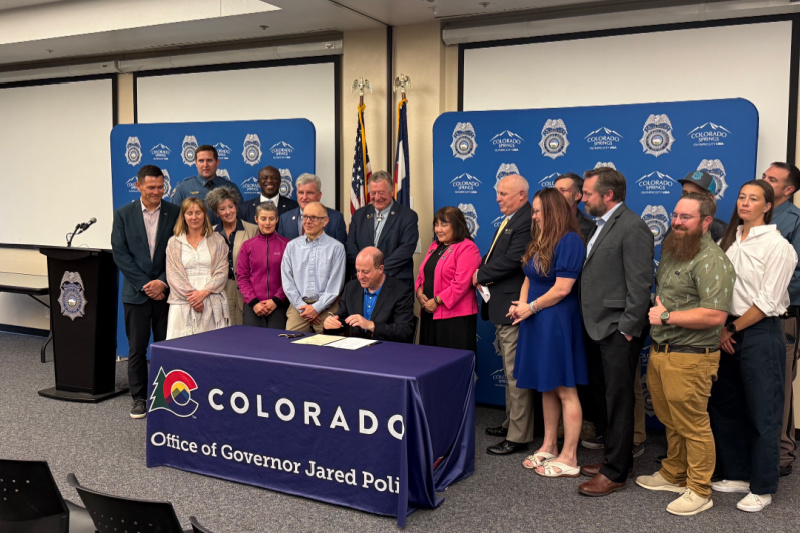
On May 28, 2026, Colorado Governor Jared Polis signed Senate Bill 26-072 into law. The bill was sponsored by a bipartisan coalition — Senators John Carson (R) and Marc Snyder (D), and Representatives Cecelia Espenoza and Bob Marshall — and passed the Colorado Senate 31 to 0. It passed the House 61 to 4. The near-unanimous margins were a signal: this was not a partisan fight. It was a matter of basic legal consistency.
The law makes two critical changes to Colorado’s criminal code.
First, it adds vehicular negligence to the definition of Criminally Negligent Homicide, elevating the charge from a Class 1 Misdemeanor to a Class 5 Felony. This means that a District Attorney can now charge a driver who kills a cyclist through criminal negligence — texting at highway speed, falling asleep at the wheel, running a red light while distracted — with a felony that carries a sentence of one to three years in prison, mandatory license revocation, and potential Habitual Offender status.
Second, it removes the statutory cap that previously limited penalties for deaths caused by mobile device use to a Class 1 Misdemeanor. Under the new law, a driver who kills a cyclist while on their phone can be charged with a felony.
The bill is not a perfect solution. Its prime sponsors acknowledged that a more ambitious version — which would have classified vehicular homicide as a “crime of violence” and triggered even longer mandatory sentences — was stripped from the legislation due to budget constraints. But it fills a critical gap that has existed in Colorado law for decades. As Senator Carson explained during committee testimony, prosecutors previously had to choose between a Class 1 misdemeanor and a Class 4 felony with no middle ground. SB26-072 creates that middle ground: a Class 5 felony that reflects the gravity of taking a life without requiring the level of proof needed for the most serious charges.
Crucially, the new law also changes what happens after a conviction. Under the old framework, a driver convicted of a misdemeanor could not be classified as a Habitual Offender, could not have their license revoked as part of the criminal sentence, and was not subject to the same mandatory restitution requirements that apply to felony convictions. SB26-072 changes all of that. A driver who kills a cyclist through criminal negligence now faces real, lasting consequences — not just a fine and a return to the road.
The legislation was driven, in no small part, by the advocacy of The White Line Foundation, founded by Jill and Michael White in the wake of Magnus’s death. Their testimony before the Senate Judiciary Committee — and the testimony of Josh Stewart, whose 13-year-old son Liam was killed riding his bicycle to school in Littleton and whose killer received two years of probation — helped make the case that the human cost of the loophole was too high to ignore.
“We’ve been here a lot,” Jill White told Denver7 during committee testimony. “For some reason this bill, testifying on this bill, for me personally, has been the hardest. It’s reliving what happened to Magnus. It’s the violence of what happened. How he was killed.”
SB26-072 also builds on another landmark Colorado law passed earlier this year. HB26-1237, signed in May 2026, officially replaced the word “accident” with “crash” throughout Colorado state statute — making Colorado only the second state in the country, alongside Nevada, to formally change this language in law. The distinction matters more than it might appear. As Jacqueline Claudia, Executive Director of The White Line Foundation, wrote when the bill was signed: “Crashes are rarely inevitable. They are the result of choices, conditions, systems, enforcement failures, dangerous behavior, road design, distraction, speeding, impairment, and policies that can and should change.” When the law calls something an accident, it implies no one is responsible. When the law calls it a crash, it opens the door to accountability.
The Federal Push for Safer Streets
Colorado’s legislative progress does not exist in a vacuum. At the federal level, two significant pieces of legislation are advancing that could reshape the national landscape for cyclist safety.
The Magnus White and Safe Streets for Everyone Act — named directly for the young cyclist whose death galvanized a national movement — passed through the House Energy and Commerce Committee in February 2026. The bill would require the National Highway Traffic Safety Administration to mandate that automatic emergency braking (AEB) systems in all new passenger vehicles be capable of detecting cyclists and pedestrians in all lighting conditions and across all clothing colors and skin tones. It is a technology-based safety net designed to account for the reality that human beings are imperfect drivers — and that the consequences of that imperfection fall disproportionately on those outside the vehicle.
On May 29, 2026, the bipartisan Congressional Bike Caucus introduced the America Bikes Act (HR 9041), a sweeping federal bill endorsed by PeopleForBikes, the League of American Bicyclists, and Rails-to-Trails Conservancy. The bill expands federal funding for local safety action plans, improves cycling infrastructure on federal lands, and reinstates the employer-provided bicycle commuting benefit that was eliminated in 2017. Together, these federal bills represent a recognition — at the highest levels of government — that the current system is failing cyclists. The question is whether Congress will act before more lives are lost.
The Deeper Problem: Why the Loophole Has Lasted So Long
Understanding why the careless driving loophole has persisted for so long requires confronting an uncomfortable truth about how Americans think about driving.
Most people, when they imagine the kind of driver who kills a cyclist, picture a drunk, reckless, or deliberately malicious person. They do not picture themselves. Yet The White Line Foundation’s 2026 Blind Spots survey — available in full here — found that 68% of Americans believe killing a pedestrian or cyclist usually results in heavy jail time. In reality, only 11% of respondents correctly identified what most often happens in the legal system. The gap between public perception and legal reality is enormous — and it is part of what allows the loophole to persist.
Nearly three in four drivers say they see speeding “all the time,” but only one in five admits to doing it frequently. The same drivers who are outraged when they read about a cyclist being killed are, statistically, the same drivers who speed, use their phones, and drive distracted. The “bad driver” is not a stranger. In many cases, the bad driver is us.
This is not an argument for leniency. It is an argument for structural change. As the Good Driver Delusion analysis of the survey data concluded: “We cannot build a transportation system that depends on every single person being perfectly attentive, perfectly regulated, perfectly patient, and perfectly self-aware at all times. Human beings are flawed. We get distracted. We rationalize. We rush. We look away. That is exactly why we are fighting so hard.”
The misdemeanor loophole is not just a legal technicality. It is a statement of values embedded in law. When a driver kills a cyclist and faces a $1,000 fine, the legal system is communicating — loudly and clearly — that a life on a bicycle is worth less than a life in a car. Colorado just changed that statement. The rest of the country has not yet done so.
What Cyclists Can Do
The passage of SB26-072 in Colorado is not just a Colorado story. It is a blueprint.
The advocacy model that produced this law — families telling their stories publicly, attorneys making the legal case, nonprofit organizations building coalitions, and legislators from both parties finding common ground — can be replicated in every state in the country. Wyoming is already working on it. Massachusetts has been strengthening its VRU laws. The momentum is real.
Know your state’s laws. Find out whether your state has a Vulnerable Road User law, and what the maximum penalty is for a driver who kills a cyclist through negligence. The League of American Bicyclists maintains a model VRU law and state-by-state resources. If your state’s maximum penalty is a misdemeanor fine, that is the fight in front of you.
Support the organizations doing this work. The White Line Foundation is at the forefront of this movement nationally, driving both legislative reform and the cultural shift that makes reform possible. Bicycle Colorado, AAA, MADD, and the League of American Bicyclists are also critical voices in this fight at the state and federal levels.
Contact your federal representatives. The Magnus White and Safe Streets for Everyone Act and the America Bikes Act both need broad support to advance. A phone call or email to your Congressional representative takes five minutes and matters more than most people realize.
Tell the stories. The single most powerful force in this legislative fight has been the willingness of families like the Whites and the Strattons to stand in front of lawmakers and tell the truth about what it means to lose a child to a driver who faced no meaningful consequence. The law changes when the human cost becomes impossible to ignore.
The Road Ahead
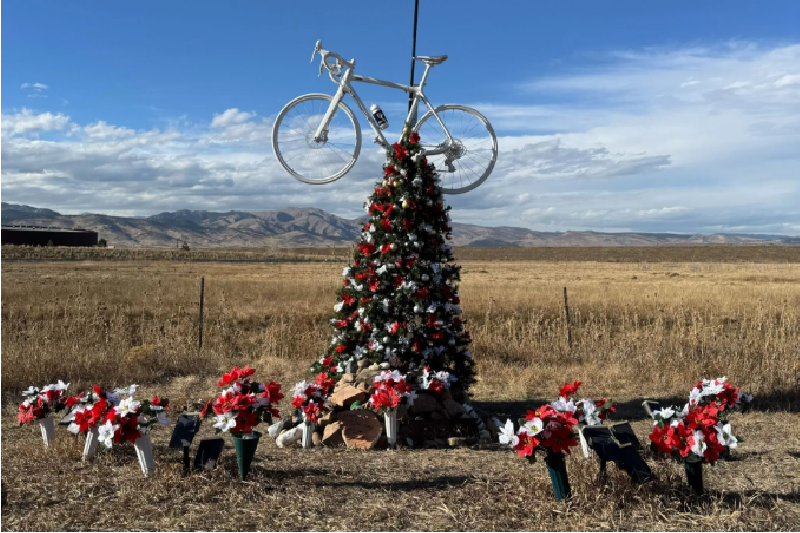
Magnus White would have turned 20 years old in November 2025. His parents decorated a Christmas tree that year and zip-tied it to his ghost bike along the Diagonal Highway in Boulder. “So everyone who passes by knows there’s a boy that loves Christmas,” Jill White said, “and he’s not here, but his parents are remembering him and how much joy he brought us during that season.”
The passage of SB26-072 will not bring Magnus back. It will not undo the pain of the Stratton family, or the family of Xi Zheng in Flushing, or the family of Liam Stewart, the 13-year-old killed riding to school in Littleton whose killer received two years of probation. But it is a recognition — written into law, passed nearly unanimously by both chambers of the Colorado legislature — that a human life on a bicycle has weight. That the choices a driver makes have consequences. That the word “accident” is not an absolution.
The careless driving loophole has existed for as long as cars and cyclists have shared the road. Colorado just proved it can be closed. The rest of the country is watching.