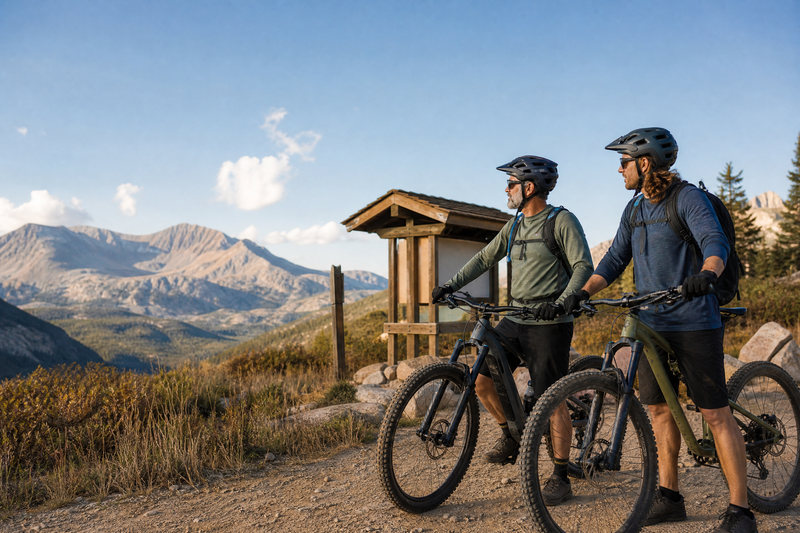
As trail systems across the country redraw the lines around electric bikes, the real question is not whether every motor belongs on singletrack. It is whether riders, land managers, and bike advocates can create rules that expand access without sacrificing safety, trust, and the trails themselves.
By: Gary Robinson, Avid Cyclist
At a trailhead, the argument begins before anyone has clipped in.
One rider sees a Class 1 pedal-assist mountain bike: a way to climb with an old knee, keep up with a faster partner, return to trails after illness, or finish a day with enough energy left for family. Another sees a machine that could change the tempo—and perhaps the character—of a trail system built through decades of volunteer work, public meetings, and uneasy compromises.
Both riders may be looking at the same bike. They are not necessarily imagining the same future.
That is why the e-bike trail-access debate has become one of cycling’s most consequential arguments. It is not only about speed. It is about who gets welcomed into a sport, how shared public land is cared for, and whether the cycling community can distinguish a low-speed pedal-assist bicycle from the far more powerful electric machines that are increasingly being called “e-bikes” in public debate.
The stakes are no longer theoretical. In February, the Bureau of Land Management’s Colorado River Valley Field Office announced a proposal to allow Class 1 e-bikes on its designated mechanized mountain-bike trails. The field office manages more than 220 miles of singletrack, but only about 18 miles were then open to Class 1 e-bikes. The BLM said it would use public input, visitor monitoring, and an environmental assessment to guide its decision. As of this article’s review date, the official project record documents the completed 2026 scoping period; riders should verify the current status with the managing agency before planning a ride.
Across the country, Montgomery Parks in Maryland has already taken a more granular approach. Its 2026 directive permits Class 1 pedal-assist e-bikes and adaptive mountain bikes on designated natural-surface trails, while continuing to prohibit Class 2 and Class 3 e-bikes, throttle-controlled devices, mopeds, and motorbikes. The agency explicitly tied those distinctions to concerns about trail damage, speed, and public safety.
Those examples point toward the more useful question: Can trail systems draw a clear, defensible line that expands access while preserving the experience and the ground under everyone’s wheels?
The Rule That Changes Everything: What Is a Class 1, 2, 3—and an E-Moto?
The discussion often collapses wildly different machines into a single word. That is a mistake. The details are not technical trivia; they determine how a bike behaves on a climb, in a passing moment, and on a narrow corridor of dirt.
|
Device
|
Basic description
|
Why it matters on a trail
|
|
Class 1 e-bike
|
Pedal-assist only; motor assistance stops at 20 mph.
|
Often the focus of access proposals because riders must pedal and the assist ceiling is comparatively modest.
|
|
Class 2 e-bike
|
Can use a throttle; motor assistance stops at 20 mph.
|
The throttle changes how the bike can be propelled, which some land managers treat differently.
|
|
Class 3 e-bike
|
Pedal-assist; motor assistance may continue to 28 mph.
|
Higher assisted speeds raise different passing, sightline, and conflict questions.
|
|
E-moto / electric motorcycle
|
A higher-powered electric two-wheeler that may not meet local, state, or federal e-bike definitions.
|
Should not be casually grouped with low-speed pedal-assist bicycles; rules and risks can be materially different.
|
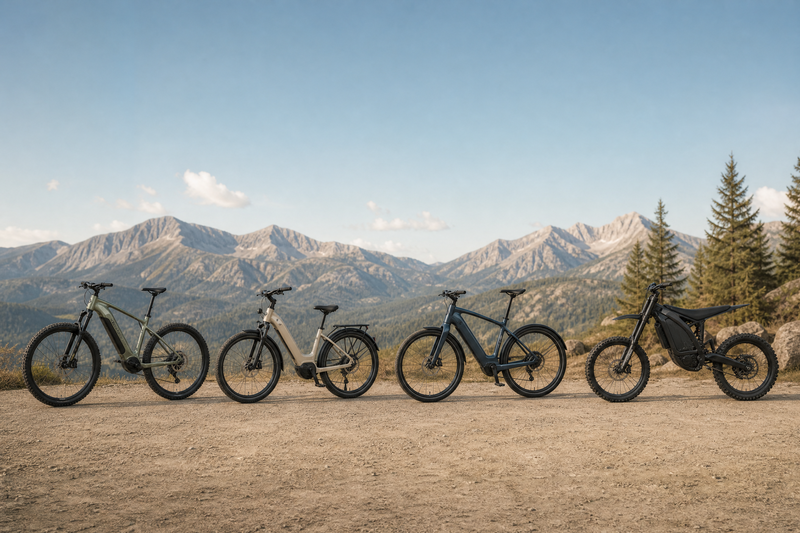
Not every electric two-wheeler is the same. Access rules should identify the vehicle class, the trail, and the managing agency rather than relying on a blanket label. Image illustration: AvidCyclist.
The law varies by jurisdiction, and a rider should never assume that a class label guarantees access. But the conceptual distinction is essential. A Class 1 bike that assists only while a rider pedals is not functionally identical to a throttle-controlled device, a 28-mph Class 3 bike, or a high-powered electric dirt bike.
That distinction is becoming harder to ignore because the market is changing. PeopleForBikes reported that conventional retail tracking missed an estimated 450,000 direct-to-consumer e-bike units worth roughly $800 million in 2024; when peer-to-peer sales were added, nearly one million e-bikes were bought or sold that year. Its analysis argues that the market is shifting toward daily transportation, cargo use, and new riders—not simply performance recreation.
For trail managers, that means the question does not arrive in a neat package. A person carrying groceries, a parent moving a child, an older rider rebuilding fitness, and a teenager on a high-powered electric machine may all be described as “e-bike riders.” The policy answer cannot be credible if it refuses to see the difference.
The People Access Rules Can Leave Behind
Cycling has long talked about accessibility in the abstract. E-bikes have made it immediate.
A rider whose health, age, disability, injury, or schedule would make a long climb unrealistic may find that pedal assist changes what is possible. For some, it is not about going farther or faster; it is about retaining a social connection to riding. For others, the appeal is simpler: an e-bike makes transportation, errands, family riding, or a return to the trail less intimidating.
That context matters at a time when the industry’s largest opportunity may be people who do not yet think of themselves as cyclists. PeopleForBikes notes that commuter-oriented models accounted for 54% of sales in one resale dataset it cites, while cargo e-bikes were among the fastest-growing categories in its analysis.
Avid Cyclist has already documented how cycling communities can widen the invitation. In its story on ABOB Denver, the site explored a local chapter created to offer welcoming, slower-paced rides for people of diverse body sizes, abilities, and backgrounds. That same principle belongs in the trail-access conversation: a trail system is not truly public if its rules ignore who needs different tools to participate.
But access must be more than a slogan. A policy that opens a trail without naming what is allowed, without teaching courteous riding, and without enforcing the line against prohibited devices will erode trust among every user group—including the riders it aims to include.
What Traditional Trail Users Are Worried About
The concerns are not frivolous, and pretending otherwise only hardens the debate.
On a narrow descent, a rider who appears quickly from behind can turn a pleasant shared-trail encounter into a tense one. On wet ground, any use that encourages riders to push through muddy conditions can accelerate damage. On a multi-use trail, hikers, equestrians, riders with children, and mountain bikers all experience speed differently. And when regulations are vague, people may assume the worst about every motor-assisted bike they see.
Montgomery Parks’ 2026 directive offers a pragmatic example. It permits Class 1 pedal-assist e-bikes and adaptive mountain bikes on designated natural-surface trails, but tells users to ride at controlled speeds, yield to pedestrians and equestrians, stay on designated trails, and avoid wet or muddy conditions. Its policy keeps higher-speed or throttle-controlled devices out of those trails.
That is not a perfect formula for every place. A hard-packed, wide trail near a population center is not the same as a rocky, remote corridor with poor sightlines. But it reveals the kind of thinking that public land requires: class-specific, trail-specific, behavior-specific rules beat broad slogans.
Avid Cyclist’s recent feature, “Can Rural Communities Build a Trail-Based Economy?”, made the case that trails can shape local opportunity. That is another reason stewardship matters. A community cannot build a sustainable outdoor economy by treating its trails as disposable—or by turning access debates into a contest between winners and losers.
The E-Bike Problem May Actually Be an E-Moto Problem
Many trail advocates have noticed the same pattern: public anger about “e-bikes” is often driven by devices that riders and regulators may not classify as ordinary bicycles at all.
has argued that the e-bike problem is frequently an e-moto problem: a failure to separate genuinely pedal-assist bicycles from high-powered electric machines and reckless behavior. That claim should not be used to dismiss legitimate safety or trail concerns. It should be used to make the rules clearer.
When someone rides a prohibited, throttle-heavy, or high-powered electric vehicle where it does not belong, trail users should not have to become amateur engineers to understand what they are seeing. Conversely, a rider on a compliant Class 1 bike should not automatically be treated as if they arrived on a motorcycle.
Clear language matters. So does education. Independent bike shops can become part of the solution by explaining classifications and local access rules before a bike leaves the floor. In “The Heartbeat Of Cycling: Why Independent Bike Shops Still Matter,” Avid Cyclist celebrated shops as places for trust, repair, and community. This is another moment for that local expertise to matter.
Who Makes the Rule? Why One Trail Can Say Yes While Another Says No
The most frustrating answer to “Are e-bikes allowed on trails?” is also the most accurate: it depends.
The answer to “Can I ride here?” may change with the land manager, trail designation, vehicle class, and local rule. Image illustration: Avid Cyclist.
|
Question to ask
|
Why the answer matters
|
|
Who manages this exact trail?
|
Federal, state, county, city, park-district, private, or nonprofit managers can set different rules.
|
|
What vehicle class do I have?
|
A Class 1, Class 2, Class 3, and e-moto may be treated differently.
|
|
Is this route specifically designated for my vehicle class?
|
A rule for paved paths or roads does not automatically apply to natural-surface singletrack.
|
|
Are there seasonal, weather, or temporary closures?
|
Even allowed use can become inappropriate or prohibited when trails are wet, damaged, or under restoration.
|
|
Where is the official rule posted?
|
A managing agency’s current trail page, map, or order is more reliable than a forum post, retailer page, or old social-media screenshot.
|
That complexity is why a single national answer is impossible—and why better public information is so important. The BLM’s Colorado River Valley proposal was limited to a defined set of designated mechanized mountain-bike trails, not an open invitation to every route on public land. Montgomery Parks’ directive likewise applies to its designated natural-surface trail system and specifies which classes are permitted.
The lesson for riders is straightforward: check before you roll. The lesson for agencies is just as clear: if a rule cannot be understood at the trailhead and confirmed online, it will be hard to follow and harder to enforce.
A Better Line to Draw
This debate does not need a villain. Not the older rider who wants one more climb. Not the volunteer who worries about a fragile corner after rain. Not the parent who wants an e-cargo bike to replace car trips. Not the hiker who wants a quiet trail. Not the mountain biker who has spent years helping build and maintain singletrack.
The real failure is the reflex to treat all electric assistance as the same, or to treat every access concern as hostility to cycling. Neither idea is true. Both make better policy harder.
A credible future for e-bike trail access would establish a few durable principles. It would distinguish compliant pedal-assist bicycles from high-powered electric motorcycles. It would respect trail-specific design, conditions, and sightlines. It would make room for adaptive, older, and returning riders. It would clearly communicate expectations for speed, yielding, and wet trails. And it would enforce rules against the devices and behavior that undermine public trust.
Colorado has an opportunity to model that approach as the BLM evaluates its proposed Class 1 expansion. The issue is not whether trails should simply open or close. It is whether a thoughtful rulebook can preserve what riders love about the trail while inviting more people to experience it responsibly.
Because the finish line in this debate should not be a louder argument at the trailhead. It should be a trail system where more people understand the rules, respect one another, and leave the ground as good as they found it.
Before You Ride: The 30-Second E-Bike Trail Check
1. Identify your vehicle correctly. Know whether it is Class 1, Class 2, Class 3, or a higher-powered electric device.
2. Check the actual land manager. Visit the official trail page, map, or notice—not only a third-party app or social post.
3. Confirm the route, not just the park. Access can vary between paved paths, roads, and individual natural-surface trails.
4. Read conditions and closures. Do not ride wet, muddy, damaged, or temporarily closed trails.
5. Ride as if access depends on your behavior. Control speed, yield generously, communicate before passing, and let every encounter strengthen—not weaken—the case for responsible access.
Rules change. This article was published on August 13, 2026. Always verify local regulations with the managing agency before you ride.