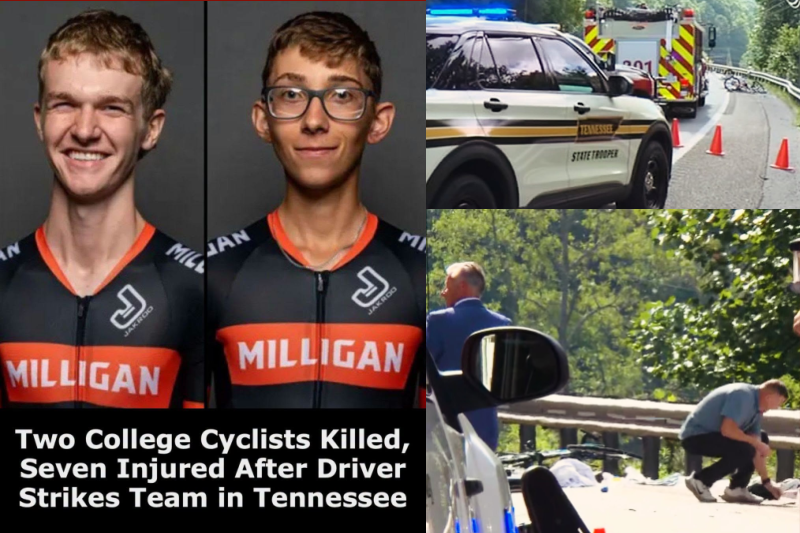
Yesterday, Aug 19th, 11 cyclists went out for a training ride in Tennessee. Seven are in critical condition in a neighboring hospital, and two will never come home.
Haylan Engdahl and Brayden Rogers were killed while riding with Milligan University teammates in Carter County, Tennessee. Seven other students were injured. The facts of this crash are still being investigated; the larger question cannot wait.
ABC News reported that 11 Milligan University students were out on a team training ride on the morning of August 19 when a vehicle struck members of their group on a highway in Carter County, Tennessee. Haylan Engdahl and Brayden Rogers, both sophomores, were killed. Seven other student cyclists were injured and taken to Johnson City Medical Center; four were reported to be in critical condition at the time of the initial reporting.
Every group rider understands the ordinary ritual of a training day: bottles filled, lights checked, a roll-out that feels routine because it is supposed to be routine. For the Milligan community, for the families of Engdahl and Rogers, and for the teammates now recovering from physical and emotional trauma, that ordinary morning has become an unimaginable loss.
This article is about a devastating crash, and the investigation into it must be allowed to proceed thoroughly and fairly. It is also about the question that follows cyclists home after every roadside memorial, every condolence post, and every story that is described as tragic as though tragedy were the whole explanation:
How many more lives have to be lost before we stop treating deaths on a bike as inevitable?
What is known so far
The collision occurred Wednesday morning on U.S. Highway 19E at Simerly Creek in Carter County, in northeast Tennessee, according to local station WCYB. The Tennessee Highway Patrol said the crash involved a vehicle and cyclists. Milligan President Stephen Waers said the group consisted of 11 students on a training ride.
|
Reported detail
|
What authorities or institutions have said
|
|
Location and date
|
WCYB reported that the crash occurred on U.S. Highway 19E at Simerly Creek, Carter County, Tennessee, on the morning of August 19, 2026.
|
|
The riders
|
Milligan University told ABC News that 11 students were participating in a training ride.
|
|
Those killed
|
|
|
Injured teammates
|
According to ABC News, seven students were transported to Johnson City Medical Center; four were reported critical in the initial hospital update.
|
|
Charges announced
|
ABC News reported, citing Carter County District Attorney General Steven Finney, that John Benfield, 69, of Newland, North Carolina, was charged with two counts of vehicular homicide by recklessness and fivecounts of aggravated assault by vehicle by recklessness.
|
|
Case status
|
WCYB reported that Benfield was in custody; authorities said the crash remains under investigation and additional charges could be possible.
|
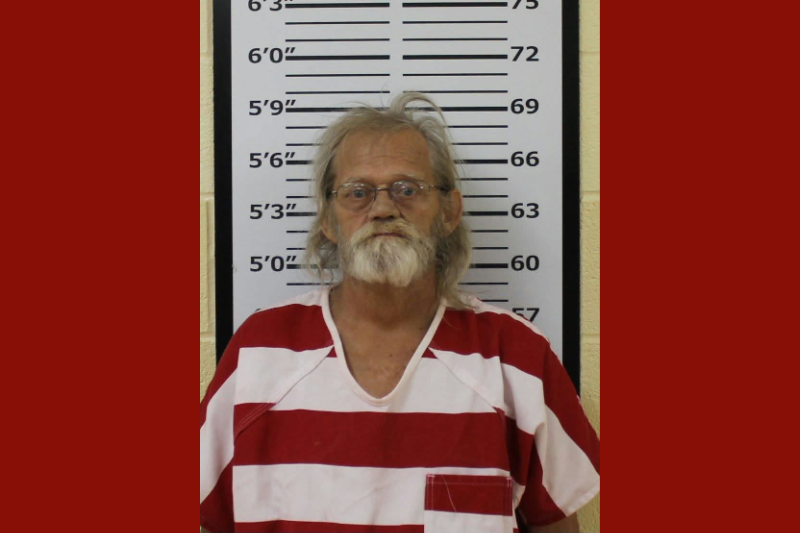
The charges are allegations, not a finding of guilt. Major Roy Brown of the Tennessee Highway Patrol told ABC News that troopers were working to determine exactly what happened and emphasized the need for a thorough, fact-based investigation. The public should resist filling that evidentiary gap with assumptions—about the driver, the riders, the road, or the seconds before impact.
That restraint is not silence. It is the basis for demanding facts, accountability where the evidence leads, and safer conditions for everyone who rides.
Names, not abstractions
Milligan described the loss in words that should stop every reader cold: the university told ABC News it was “profoundly shocked and saddened,” adding that there are “no words to adequately describe this level of loss.” The school said it was offering pastoral and counseling resources as its community began to grieve.
ABC7 Chicago reported that Engdahl was remembered by his former school community in Wisconsin as a young man with energy, faith, and an infectious smile. Jeff Bogaczyk, head of Christian Life School in Kenosha, called him “a beautiful person” with a “magnetic personality” who loved life.
Those descriptions matter because a cyclist should never be reduced to a cautionary statistic or a blur at the edge of a crash report. Engdahl and Rogers were students, teammates, friends, sons, and people with futures still unfolding. Their injured teammates are not merely a number in a headline; they are young people whose lives have been divided into before and after.
“Tragic” must not become a substitute for action
There is a difference between acknowledging that a crash is tragic and accepting that it was unavoidable. We do not yet know every fact that led to this collision. No responsible person should claim that a specific road redesign, enforcement action, piece of equipment, or individual choice would definitively have prevented it.
But one unresolved investigation does not excuse a settled national pattern. The National Highway Traffic Safety Administration reports that 1,103 bicyclists were killed in U.S. traffic crashes in 2024, while an estimated 52,887 were injured. Those are not numbers that make a death in Carter County less personal. They make the personal loss impossible to dismiss as an isolated inevitability.
The Federal Highway Administration’s Safe System framework begins with a premise that should guide both policy and public conscience: people make mistakes, and people outside motor vehicles are especially vulnerable to the forces involved when mistakes occur. The goal, therefore, cannot simply be perfect behavior from every road user at every moment. It must be transportation systems that reduce the likelihood that a human error becomes a fatal or life-altering event.
That is not an argument against personal responsibility. It is an argument against the fiction that personal responsibility alone is enough. A cyclist can ride attentively, train with an experienced team, use lights, signal clearly, and follow the law—and still be catastrophically exposed to the speed and mass of a motor vehicle. A driver can intend no harm and still make a mistake with irreversible consequences. Safe roads must account for both realities.
What refusing inevitability looks like
For drivers, the immediate obligation is simple even when the road situation is not: slow down, look farther ahead, yield when required, and do not squeeze past a person on a bicycle. If passing cannot be done with ample room and a clear margin for error, waiting is not an inconvenience; it is the responsible choice. Federal bicycle-safety guidance specifically urges drivers to give cyclists room, yield appropriately, and reduce speed around people on bikes.
For transportation agencies and elected officials, the response must be more than condolences after the fact. Serious crashes involving people walking and biking should trigger rigorous reviews of the corridor and its surrounding network: operating speeds, sightlines, lane widths, shoulders, crossing movements, lighting, bicycle demand, maintenance, and the options available to people who do not have the protection of a vehicle around them. The Safe System approach calls for attention to safe speeds, safe roads, safe vehicles, safe road users, and post-crash care—not a single silver bullet.
For cyclists, teams, clubs, and advocates, the task is to continue insisting that riding on public roads is a legitimate use of public roads. That means pushing for decisions rooted in data and safety rather than asking people on bikes to solve a systemic danger through visibility gear alone. It means supporting injured riders and grieving communities without turning their pain into spectacle. And it means recognizing the limits of even the best individual precautions.
For everyone reading this story, the most meaningful response today may be a quieter one: share verified information, give grieving families and teammates room, check in on the cyclists in your life, and carry the urgency of this loss into the next conversation about road design, speed, enforcement, funding, and the everyday choices made behind a steering wheel.
The question remains
The criminal case will proceed through the courts, and investigators will continue to determine the facts of this collision. Avid Cyclist will follow credible updates and correct or update this report as warranted.
But the question is larger than one case, one driver, one team, or one stretch of highway.
How many more names must be added to memorial rides, jersey backs, scholarships, and roadside ghost bikes before we stop saying this is simply what happens when people ride bicycles on roads built for cars?
Engdahl and Rogers should be remembered for more than the way their lives ended. Remembering them also requires rejecting the idea that their deaths—or anyone else’s—are an acceptable cost of moving through the world on two wheels.
That is not inevitability. It is a choice. And choices can be changed.