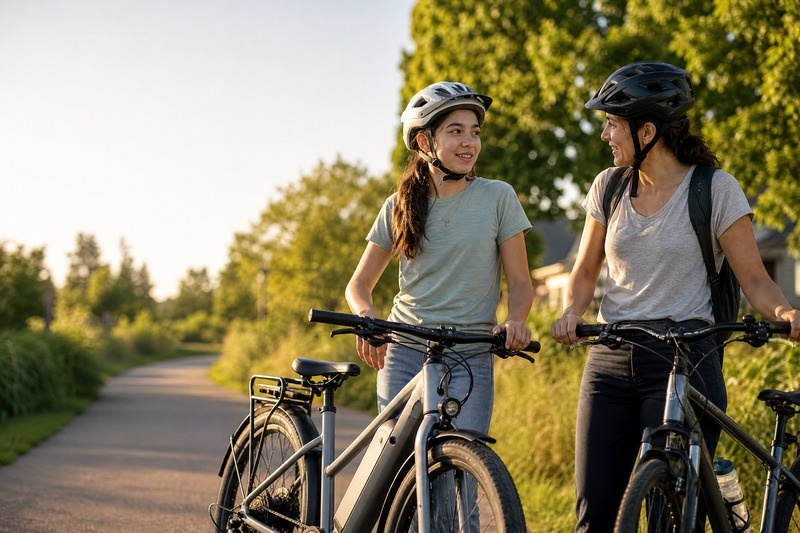
Kids and teens are finding freedom on two wheels. Here is how families, shops, schools, and experienced riders can help them ride smart—without pushing them away from cycling.
The next generation is discovering the freedom of two wheels. The question is whether the cycling community will give it the guidance to last.

There is a familiar moment in almost every cyclist’s life: the first time a bike makes the world feel bigger. The corner store is no longer far away. A friend’s house is suddenly within reach. A quiet road, a park path, or a trailhead becomes an invitation rather than a boundary.
For a growing number of kids and teens, that feeling is arriving on an e-bike.
That is not automatically a problem. A thoughtfully chosen, age-appropriate e-bike can make a family ride more attainable, help a young person travel farther than their current fitness permits, and replace another short car trip with time outside. Children’s Mercy, a pediatric health system, describes e-bikes as a way for young people to get around faster, spend more time outdoors, and make family rides easier—while emphasizing that added speed demands added responsibility.
The challenge is that a young rider’s new freedom can arrive with more speed, more weight, more technology, and less instruction than the first pedal bike ever did. At the same time, the public conversation too often collapses every electric two-wheeler into one alarming category. A compliant pedal-assist bicycle, a throttle-equipped e-bike, and a high-powered electric motorcycle are not the same machine, and responsible young riders should not be treated as though they are.
This is not a story about keeping young people off bicycles. It is about inviting them into cycling.
The Bike Still Means Freedom
Every generation finds its own version of independence. For many adults, it was a one-speed bike and a parent’s instruction to be home before dark. For today’s young riders, an e-bike can broaden the map: the route to school, the park across town, a friend’s neighborhood, a family outing that once felt too hilly or too long.
That promise is worth protecting. Cycling is exercise, transportation, play, connection, and an escape from a life lived largely through screens. It can build confidence without requiring a podium, a carbon frame, or a particular kind of rider. AvidCyclist was built around that inclusive idea: there is room for the seasoned racer, the weekend rider, and the person discovering the joy of a bike for the first time.
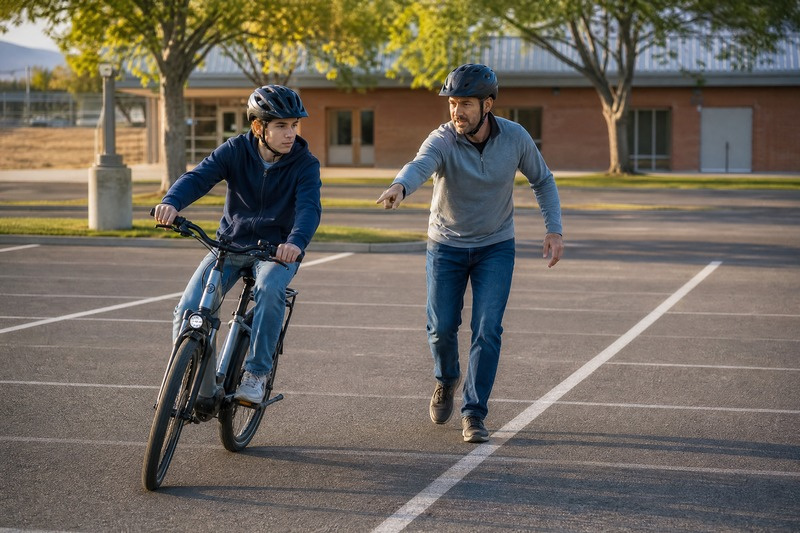
But freedom is learned. The first pedal-bike ride usually came with someone running beside the saddle, a few wobbly turns in an empty lot, and a steady voice saying, “Look where you want to go.” Young e-bike riders deserve the same patient preparation. They need more than a charged battery and a delivery box on the porch.
The Machine Matters—So Does the Label
The most helpful place to begin is with a distinction that should be simple but is often not. Not every electric two-wheeler marketed online, shown in a viral video, or called an “e-bike” behaves like a bicycle.
AvidCyclist’s recent trail-access feature explains why the vehicle class matters. A Class 1 e-bike provides pedal assistance only and stops assisting at 20 mph. A Class 2 e-bike can use a throttle and also stops at 20 mph. A Class 3 e-bike provides pedal assistance up to 28 mph. Higher-powered electric motorcycles, sometimes called e-motos or electric dirt bikes, can be legally and functionally different from all three.
That distinction is not an invitation to argue over labels at a trailhead. It is a practical question for every parent, retailer, school, and rider: What exactly is this machine designed to do, where is it allowed, and is this young person prepared to operate it?
A family should ask those questions before the purchase, not after the first close call. A shop should be able to answer them plainly. A school should communicate its parking and campus expectations in language families can understand. And experienced cyclists should resist the urge to dismiss all young electric-bike riders because of the behavior of a few people on machines that may not be bicycles at all.
The Gap Between Buying a Bike and Teaching a Rider
A bicycle has always needed some instruction. How to start. How to brake. How to look over a shoulder without drifting. How to see a parked car not as an obstacle but as a door that could open. How to yield with grace on a path. How to understand that another person’s bad decision is not an excuse for our own.
An e-bike does not erase those lessons. It raises the stakes for learning them.
Recent reporting from Southern California has highlighted the consequence of treating this as somebody else’s problem. In a story about youth e-bike and e-motorcycle incidents, ABC News and the Associated Press reported that Orange County authorities had opened investigations involving parents and that other jurisdictions were exploring rules that clarify parental responsibility. The legal details differ from place to place, and this article is not a state-by-state law guide. The larger lesson, however, applies everywhere: adults cannot outsource judgment to a product label, a social-media trend, or a local ordinance.
The most productive response is neither panic nor permissiveness. It is a culture of learning. Before a young rider heads onto a busy street or a mixed-use trail, someone should have practiced with them in a low-pressure setting. That person might be a parent, an older sibling, a coach, a bike-shop employee, or an experienced family friend. What matters is that the instruction is real.
What Smart Freedom Looks Like
No checklist can replace attention, maturity, or local knowledge. Still, families benefit from making expectations visible. The following agreement is designed as a conversation starter—not a substitute for local rules, professional instruction, or a parent’s judgment.
| Before a young rider goes farther | The family conversation to have |
| Know the machine. | Is this a pedal-assist e-bike, a throttle-equipped e-bike, or a higher-powered electric motorcycle? What are its speed and power settings? |
| Fit the rider and the equipment. | Can the rider reach and use the controls comfortably? Is the helmet fitted correctly? Are lights, reflectors, closed-toe shoes, and visible clothing part of the routine when appropriate? |
| Practice the basics first. | Has the rider practiced controlled starts, deliberate stops, emergency braking, turns, shoulder checks, and slow-speed balance away from traffic? |
| Choose the route together. | Which streets, paths, crossings, and trail sections are appropriate today—not eventually, but today? |
| Set a speed-and-etiquette standard. | Can the rider explain when to slow down, yield, announce a pass, give walkers space, and stop riding when conditions are too crowded, dark, wet, or uncertain? |
| Keep the phone put away. | Is there a clear expectation that riding requires full attention, with navigation or music set before moving? |
| Check the actual local rule. | What does the current city, park, school, or land manager allow for this rider and this vehicle? Rules can vary, so use the relevant official source rather than a screenshot or rumor. |
The spirit of this agreement matters more than the format. A young person who understands why a rule exists is more likely to carry that judgment into the moment when no adult is standing nearby.
The Adults Who Can Change the Story
Parents are not alone in this work. One of the most valuable assets in any cycling community is the local person who knows how to turn uncertainty into confidence.
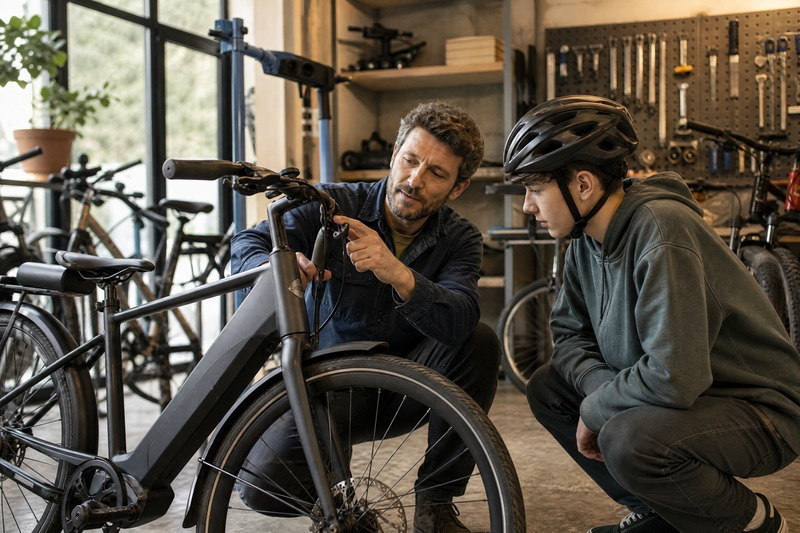
That may be the bike-shop mechanic who takes an extra ten minutes to explain brake feel and tire pressure. It may be the group-ride leader who welcomes a young rider but sets a clear standard for path etiquette. It may be the coach who makes slow-speed skills look as important as fitness. It may be the teacher, crossing guard, or local advocate who knows which routes are genuinely safer and which “bike-friendly” roads are not ready for an inexperienced rider.
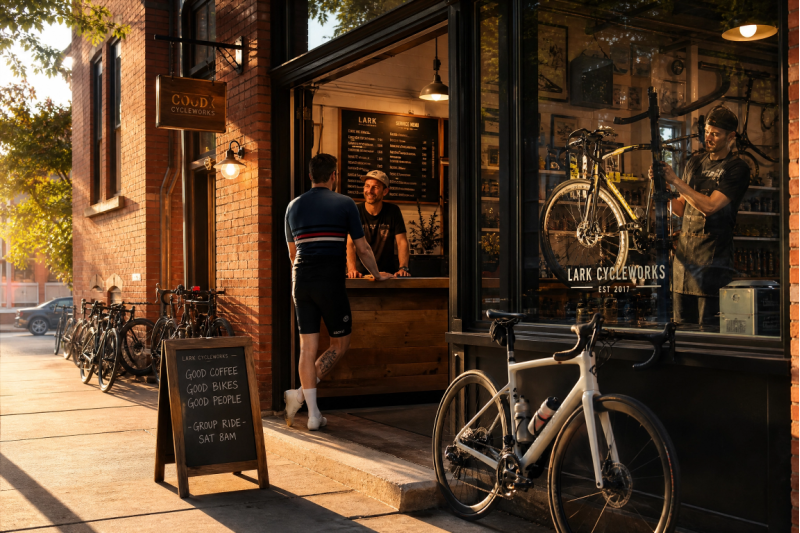
Independent bike shops are especially well positioned to help. AvidCyclist recently called them “the heartbeat of cycling,” not only because they repair bikes, but because they translate
equipment into confidence and turn newcomers into members of a local riding culture. That role is even more important now. An e-bike sale should be an opportunity for a conversation about fit, classification, local access, batteries, riding behavior, and the first places a new rider should practice.
Do Not Let Fear Steal the Bike
There are real reasons for concern. Speed changes the margin for error. Heavier machines demand thoughtful handling. Local rules are changing as cities and schools respond to incidents, public pressure, and the confusing mix of products being marketed to families.
But fear alone is not a cycling culture.
If the only message young people hear is “You do not belong here,” they will not learn the habits that make every rider safer. They will not discover the camaraderie of a group ride, the satisfaction of a self-powered errand, the quiet of a greenway, or the feeling of making a corner smoother than they did last week. They will not become the next generation of riders who volunteer for trail work, support local shops, advocate for safer streets, or teach another child to balance.
The better message is harder, but more useful: You belong here. Your choices matter. Let us show you how to ride with skill, generosity, and respect.
That does not mean every machine belongs everywhere, every route is appropriate for every rider, or every young person is ready for the same level of independence. It means the cycling community should respond with discernment rather than contempt. Rules should be clear. Product labels should be honest. Adults should be present. And young riders should be treated as future members of the community, not merely as a problem to control.
The Next Ride Is the Lesson
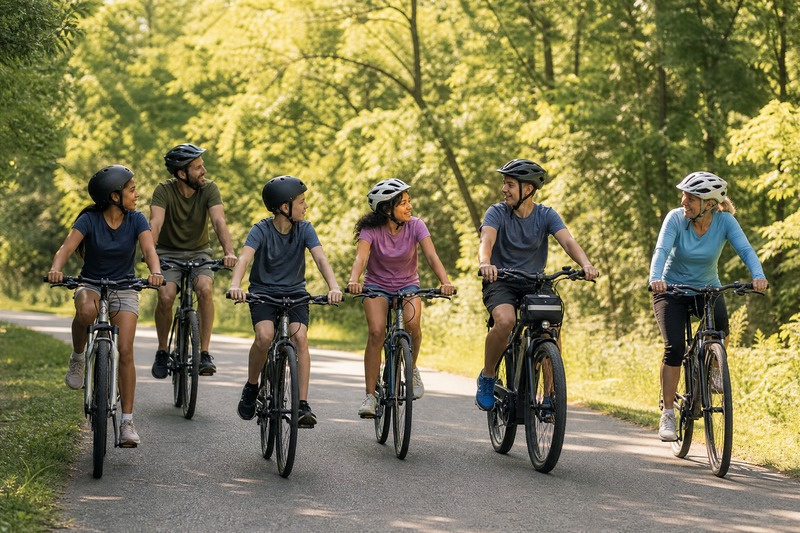
The next time a young rider asks for an e-bike, start with more than the price, the color, and the speed setting. Ask where they want to go. Ask what they already know. Ask who can ride with them the first few times. Ask what freedom means to them—and what responsibility has to travel with it.
Then take them somewhere quiet. Practice the brake lever. Practice the shoulder check. Practice the moment of yielding, slowing, and looking out for someone else.
The goal is not to make every young rider afraid of the world. It is to help them meet the world with the skill and judgment that a bicycle has always asked of us.
Share Your Story
Who taught you to ride—and who are you teaching now? Tell AvidCyclist about the parent, shop, coach, teacher, neighbor, or riding friend who helped make two wheels feel like freedom. The stories that build a safer cycling culture are usually passed person to person.