By: Carson Blume
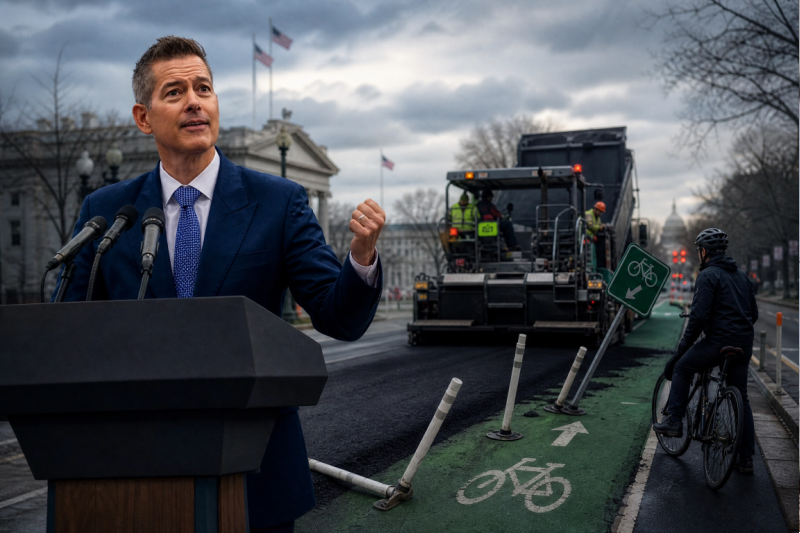
Look, I’ve seen a lot of theater in my time. Men in suits standing behind podiums, announcing things like they just discovered fire. This week it was Sean Duffy, Trump’s Transportation Secretary, posting online like he’d single handedly slain a dragon. “I just redirected $1.73 billion in USDOT grants away from Biden era DEI pet projects,” he crowed. The dragon, apparently, was bike lanes.
Here’s what actually happened. That $1.73 billion sits inside one program, BUILD, which used to be called RAISE. Under Biden, about twenty percent of that pot went toward pedestrian and bike infrastructure. Under Duffy, that number just dropped to zero. The money did not vanish. It got rerouted into roads, bridges, and ports, most of it pouring straight into asphalt and steel.

This is not “all the federal money for bikes.” Not even close. There are other rivers feeding this system that have nothing to do with one man’s grudge against the word equity. Programs like Transportation Alternatives quietly funnel more than a billion dollars a year into trails and bikeways. There is bike and pedestrian money hiding inside bigger highway programs too, the kind most people never hear about because they do not have a press conference attached.
So what did Duffy really do? He grabbed the most visible, most politically useful pot of money and used it as a prop. A morality play about waste and ideology, dressed up as fiscal responsibility. At the same time, he is sending letters that tell cities and states their funding can be withdrawn or clawed back if it smells like “DEI” or climate, even when we are talking about basic safety for people walking or biking.
That is where the real damage happens. It is not just about blocking some future grant application. It is about making local governments afraid that if they build the project that was promised, if they pour the concrete and stripe the lanes, the federal share might never show up. They might be left holding the bag, scrambling to backfill with local dollars, watching public support curdle as the bill comes due.
Because once a community gets burned like that, the next time someone proposes a protected lane or a road diet, the memory is not “we made this street safer.” The memory is “we got punished for trying.” That kind of pain is not a bug in this strategy. The pain is the feature, not a bug.