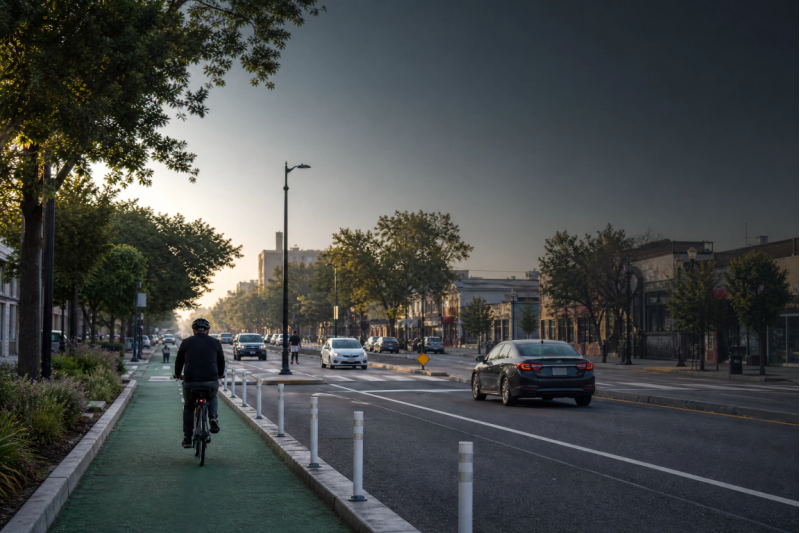
By Gary Robinson: Avid Cyclist
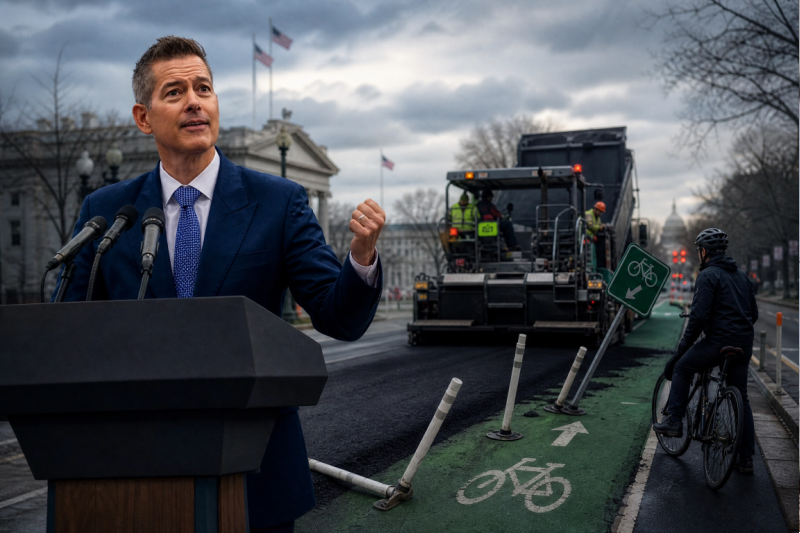
The phrase “DEI bike lanes” has become a flashpoint in the Trump administration’s transportation agenda. In a recent All Things Considered interview on NPR, transportation correspondent Joel Rose reported that Transportation Secretary Sean Duffy used the phrase while discussing a July funding announcement. Rose said Duffy had not explained exactly what he meant by it, but placed the rhetoric in contrast with the Biden administration’s public emphasis on the equity benefits of bicycle and trail investments.
The label is provocative, but the stakes are concrete. Federal transportation policy can influence which projects are competitive for grants, which safety tools planners see endorsed by the Federal Highway Administration, and what priorities Congress may consider when it rewrites the nation’s surface-transportation law. It does not mean Washington can unilaterally erase every locally approved bike lane. Cities and states still make most street-design decisions. But federal funding, research, and guidance help determine which local projects get built—and which never get past the planning table.

What the administration has done—and what it has proposed
The clearest way to understand the moment is to separate three related, but distinct, developments.
| Federal action or proposal | What is documented | Why it matters for cycling |
| Grant priorities | In its July 7 BUILD-grant announcement, DOT reported $1.73 billion for 127 projects. Its release allocated about 77% of the total to roads and bridges, with other awards for transit, ports, rail, truck parking, and aviation. | The announcement emphasizes conventional roadway and freight infrastructure. NPR reported that Duffy paired the funding round with the “DEI bike lanes” rhetoric, although the official grant release itself does not use that phrase. |
| Federal safety guidance | The FHWA’s current Proven Safety Countermeasures page says its strategies are intended to reduce fatalities and serious injuries for all road users. Bicycle lanes, road diets, speed-safety cameras, variable speed limits, and context-appropriate speed limits no longer appear in the list. | Local agencies still can use those tools, but their removal from a national best-practices resource reduces their federal visibility and can affect how officials frame safety choices. NPR reported that the removals occurred without a public explanation. |
| Surface-transportation proposal | A Holland & Knight legal-policy summary of Duffy’s letter to congressional leaders says the administration has proposed “prioritizing motor vehicle travel over bicycle lanes” in the next federal authorization. The proposal is not law; Congress would have to act. | If enacted, that priority could restrict competitive and formula funding for bicycle infrastructure that reduces vehicle lanes, reshaping long-term federal support for local active-transportation projects. NPR’s interview explains the reported policy concern. |
The administration’s position is not difficult to identify. Duffy has argued that taking away vehicle lanes for bicycle facilities can add congestion. “I do think you see more congestion when you add bike lanes and take away vehicle lanes,” he said in an archived comment replayed in NPR’s interview. “I think that’s a problem.”
That argument deserves to be addressed on its merits. Street changes can alter vehicle delay, freight movement, transit operations, and access; they should be designed and evaluated in context. But an honest discussion cannot stop at the number of car lanes. It has to account for speed, crash risk, crossings, land use, loading, transit, the needs of people walking or rolling, and the practical alternatives available to people who do not—or cannot—drive.
The safety question is larger than cycling
NPR’s interview is most useful when it shifts the debate from political shorthand back to road safety. Rose told host Rob Schmitz that bike lanes can influence more than bicycle comfort:
“The data shows that just the presence of a bike lane can make cars slow down, and lower speeds are safer for everybody.”
That does not mean every bike lane is equally effective, or that every street should receive the same treatment. Research from the Insurance Institute for Highway Safety illustrates why design details matter. In a study of 604 injured adult cyclists in Washington, D.C., New York City, and Portland, Oregon, raised or bridge-separated two-way protected lanes were associated with lower crash-or-fall risk than major roads with no bicycle infrastructure. Yet two-way protected lanes at street level showed higher risk in that analysis, while one-way protected lanes differed little from major roads. The study points to junctions, intersections, tracks, temporary obstacles, and the underlying road environment as consequential design variables.
The lesson for advocates and policymakers is not that a painted stripe is a universal answer. It is that road design requires evidence, context, and iteration. A federal government that removes tools or discourages facilities categorically makes that work harder—not because local governments lose all authority, but because they lose a layer of national technical support and funding alignment.
David Harkey, president of the Insurance Institute for Highway Safety, made that broader point in NPR’s report after the removal of the Pedestrian Bike Crash Analysis Tool from federal websites. His concern was not limited to people on bicycles:
“Safety involves everyone on the roadway. And so if you really truly believe as an agency that your job is to make sure safety is a priority, then you cannot remove tools and resources that are there to help you address those 20% of the fatalities on our roadways.”
Why cyclists should care about federal guidance
It is tempting to see this as an argument over language: an administration uses a charged phrase, critics object, and the news cycle moves on. But language can signal a change in what government is willing to count as legitimate transportation policy. In this case, the signal is accompanied by BUILD-grant decisions, altered FHWA safety guidance, and a legislative wish list that favors motor-vehicle travel over bicycle lanes.
The current FHWA page still promotes measures that can benefit people walking—such as pedestrian hybrid beacons, refuge islands, flashing beacons, and walkways—and it still describes its countermeasures as serving all road users. That is important. So is the fact that the page no longer includes several speed-management and bicycle-related tools that NPR identified as having been removed. Advocates should resist the false choice between “cars” and “bikes.” Safe streets are not an anti-driver project; they are a way to reduce the severity of inevitable human mistakes across a shared transportation system.
For the cycling community, the constructive response is to be specific. Defend projects with local crash data, travel patterns, access needs, and designs that address real conflict points. Ask agencies to explain how they will evaluate safety when federal guidance changes. And insist that debates over congestion include the safety and mobility of everyone using the corridor—not only the people moving through it behind a windshield.
The debate around “DEI bike lanes” may be political. The everyday question is practical: Will federal transportation policy help communities build streets that give people more safe ways to move, or will it narrow the range of solutions before local planners and residents can even weigh them? For cyclists, pedestrians, and responsible transportation leaders, that question deserves far more than a slogan.